
Getting up from a chair without pushing off the armrests. Climbing the front porch steps with a grocery bag in each hand. These are the small moves that keep you living on your own terms, and they are trained. Below are 14 functional exercises for seniors you can do at home, built to sharpen the strength, mobility, and balance everyday life asks for.
You will find a quick mobility warm-up, four lower body moves, three upper body moves, four core and balance moves, and a simple three-day weekly plan at the end. Three of the moves feature the TRX Suspension Trainer™ as an assisted progression. Skip those if you do not own one, or lean into them if you do.
Quick medical note before you start. Talk to your doctor before beginning any new exercise routine, especially if you have heart conditions, recent surgery, joint replacement, or a history of falls. Stop any movement that causes sharp pain, dizziness, or chest discomfort. This article is for general education, not medical advice.
Why Functional Exercises Belong in Every Senior's Routine
Functional fitness is the pattern-based training that maps to real life. Every squat pattern rehearses standing up from the couch. Every step-up rehearses climbing the curb outside the coffee shop. That is why it belongs in a senior routine. It is training that pays you back in independence. The joints and connective tissue doing that work change with age too, which is where collagen and colostrum for joint and gut support enter the conversation.
The CDC's Physical Activity Basics for Older Adults recommends 150 minutes of moderate activity per week, muscle-strengthening work at least two days a week, and dedicated balance activity. Functional fitness exercises for seniors hit all three at once, which is a rare bargain.
Fall prevention adds a second angle. According to CDC data on adult falls, roughly one in four adults 65 and older falls each year in the United States. Balance and lower body strength are the two most trainable defenses, and functional exercise sharpens both without pulling you into a machine-heavy gym setup.
Muscle loss makes the third case. NIH research on muscle tissue changes with aging shows adults lose roughly 3% to 8% of muscle mass per decade after age 30, and that rate accelerates after 60. Strength training slows the drop and, in many cases, reverses it. TRX has been built on that idea for over two decades under one simple mission. Move better, grow stronger, live longer. Randy Hetrick, the Navy SEAL who invented the first Suspension Trainer, built the tool from a jiu-jitsu belt and parachute webbing because he needed strength that traveled with him. That same portability and scalability is exactly what senior training benefits from most.
Before You Start: Setting Up Your Functional Fitness Routine
You do not need a home gym. Most of these functional bodyweight exercises for seniors ask for a sturdy chair, a step or low bench for step-ups, a set of light dumbbells or a couple of full water bottles for loading, and an optional resistance band. If you own a Suspension Trainer, keep it anchored in a doorframe or overhead beam so it is ready to go.
Clear at least six feet of floor around you on a non-slip surface. Keep water within reach. Wear closed-toe shoes with grip. Slippers are not the move.
Stand or sit tall with a long spine and the ribs stacked over the hips. Brace your core lightly, like you are getting ready to laugh. Exhale on the effort of every rep, inhale on the release. And one more time on the disclaimer. Talk to your doctor before you start, and stop any move that hurts.
Mobility and Warm-Up Functional Exercises
Three to five minutes of mobility work matters more after 60, not less. Joints take longer to lubricate. Tissues need more time to wake up. Cold strength work is where small tweaks turn into missed weeks. Run these three moves before every session, no matter what you are training.
1. Neck and Shoulder Rolls
Years of desk work, phone use, and driving pull the upper back into a hunched position. This move opens the neck and shoulders so turning to check a blind spot or reaching for the top shelf stops feeling like a wrestling match.
Sit or stand tall with a slight chin tuck. Roll your shoulders up, back, and down for 8 to 10 reps. Then slowly roll your head side to side and front to back for 5 reps each direction.
Keep your shoulders relaxed and down, away from your ears the entire time. If anything pinches, shrink the range until it does not.
2. Standing Hip Circles
Hips are the number one stiffness spot after 60. Loose hips mean easier stairs, easier bending, and an easier stand from the driver's seat.
Stand behind a sturdy chair with both hands resting lightly on the seat back. Draw five slow circles with one knee in each direction, then switch legs.
Move from the hip joint, not the knee. Keep your standing leg soft and your chest tall.
3. Ankle Rocks
Stiff ankles are the silent driver of balance loss. When your ankles cannot adjust to uneven ground, a small stumble on a curb turns into a real fall.
Stand with feet hip-width and hands lightly on the chair. Rock forward onto the balls of your feet, then back onto your heels in slow, controlled motion for 10 reps.
Move from the ankles only. If your whole leg is swinging, slow it down.
Lower Body Functional Exercises for Everyday Movement
Leg strength is the single biggest predictor of independence in older adults. Every stair, every curb, every stand from the recliner is leg-driven. The functional strength exercises for seniors below map straight onto that pattern, which is exactly what makes functional strength training worth the effort. Breathe out on the way up, in on the way down.
4. Sit-to-Stand (Chair Squat)
This is the most functional lower-body pattern there is. It trains standing up from a chair, a toilet, or a low couch, which is the exact skill that quietly predicts long-term independence.
Sit on the edge of a sturdy chair with feet hip-width and flat on the floor. Lean your chest slightly forward, drive through your heels, and stand fully upright. Sit back down with control. Do 8 to 12 reps for 2 sets.
Keep your knees tracking over your toes. Do not let them cave inward as you stand.
5. Step-Ups
Step-ups train the exact pattern you use every time you climb stairs or step onto a curb. They build single-leg strength that regular squats miss.
Face a sturdy step or low bench with a wall or railing to one side for balance. Step up with your right foot, bring the left foot up next to it, then step back down leading with the right. Do 8 reps per leg for 2 sets.
Push through the whole foot on the step, not just your toes. Take the same clean step down every rep. No leaping.
6. TRX-Assisted Squat
If you own a Suspension Trainer, this is your flagship lower body progression. The strap assist takes balance and knee load out of the equation, so you can train the squat pattern deeper and more often without paying for it the next day.
Anchor your Suspension Trainer overhead in front of you. Stand facing the anchor, feet hip-width, and hold the handles at chest height with light tension. Sit your hips back and down as if reaching for a chair behind you, then drive through your heels and stand back up, using the straps for as much assist as you need. Do 8 to 12 reps for 2 sets.
Keep tension on the straps for the whole rep. Progress by pulling less on the handles until your legs are doing more of the work.
7. Heel Raises
Calves keep your walking efficient and your balance steady, especially on stairs and uneven sidewalks. Weak calves are a quiet contributor to the shuffling gait most people associate with aging.
Stand behind a chair with your hands resting lightly on the seat back. Rise up onto the balls of your feet, pause for a beat, then lower with control. Do 12 to 15 reps for 2 sets.
Keep your weight evenly distributed across the whole foot. No rolling out to the pinky-toe side.
Upper Body Functional Exercises for Daily Life
Pressing, pulling, and carrying strength keeps groceries carryable, top shelves reachable, and your upper back out of the classic hunched-forward posture that decades of desk work bake in. These at-home functional exercises for seniors round out the routine on the upper half. Two of them are timeless staples; the third layers in one of our favorite TRX exercises for building pulling power. Same breathing rule. Exhale on the effort.
8. Wall Push-Ups
Wall push-ups are the safest way to train the pressing pattern that keeps your shoulders stable and your chest strong. Change the resistance by adjusting how far your feet are from the wall.
Stand facing a wall with your hands at chest height, slightly wider than your shoulders. Walk your feet back until your body is on a slight incline. Bend your elbows to lower your chest toward the wall, then press away. Do 8 to 12 reps for 2 sets.
Keep your body in one long line from head to heels. No sagging hips. No leading with your head.
9. TRX Low Row
This is the pulling half of the puzzle. Rowing builds the posture strength that draws your shoulders back and pulls your upper back out of the hunched position most seniors carry from years at a desk.
Stand facing the Suspension Trainer anchor and hold the handles at chest height with arms straight. Walk your feet forward under the anchor so your body leans back at an angle. Pull the handles toward your ribs by driving your elbows straight back, squeezing your shoulder blades together at the top. Lower with control. Do 8 to 12 reps for 2 sets.
Keep your body in one long line, no bending at the hips. Scale difficulty by walking your feet closer to the anchor (harder) or farther back (easier).
10. Farmer's Carry
Grip strength and full-body stability show up in every daily task worth caring about. Hauling groceries from the car to the kitchen in one trip. Holding a grandchild's hand across a busy parking lot without your grip giving out.
Hold a dumbbell, kettlebell, or full water jug in each hand at your sides. Walk 20 to 30 steps at a steady pace with tall posture. Rest 30 seconds. Complete 3 rounds.
Stand tall with your shoulders down and back. Do not let the weight pull you into a slump.
Core and Balance Functional Exercises
The core stabilizes everything above and below it, and balance is trainable at any age. Falls remain the leading cause of injury in adults 65 and older, and dedicated balance work is the direct countermeasure. NIH research on diagnostic balance tests points to single-leg stance time as one of the strongest home-testable predictors of fall risk we have. These functional balance exercises for seniors train core and balance together, so your time investment pays out in two categories at once.
11. Dead Bug
The dead bug teaches your core to stabilize your spine while your arms and legs move independently. That is the exact skill that keeps you safe when you bend, twist, and reach around the house without tweaking your back.
Lie on your back with your knees bent 90 degrees over your hips and your arms straight above your shoulders. Slowly lower your right arm overhead and extend your left leg straight until both hover an inch above the floor. Return to start and switch sides. Do 8 reps per side.
Keep your lower back pressed lightly into the floor the whole time. Move slow. Speed defeats the purpose.
12. Glute Bridge
The glute bridge strengthens the glutes and hamstrings that power every stand from a chair, every step up, every stumble recovery. As a bonus, it decompresses your low back after a day of sitting.
Lie on your back with knees bent, feet flat on the floor hip-width apart, and arms at your sides. Drive through your heels and lift your hips until your knees, hips, and shoulders form a straight line. Squeeze your glutes at the top, then lower with control. Do 10 to 12 reps for 2 sets.
Squeeze your glutes to lift, not your low back. Keep your ribs down.
13. Single-Leg Balance
Single-leg stance time is one of the strongest home-testable balance benchmarks we have. Training the pattern near a chair, where you can safely fail, is how you keep balance from quietly slipping.
Stand behind a chair with your fingertips resting on the seat back for balance. Lift one foot a few inches off the floor and hold for 10 to 30 seconds. Switch legs. Do 2 to 3 sets per leg.
Progress by lifting your fingertips off the chair. The ultimate progression is holding the balance with your eyes closed.
14. TRX Balance Lunge
This is the peak combo move. You are training balance, single-leg strength, and hip stability all in one rep. The Suspension Trainer turns what could be a scary lunge into a safely trainable move.
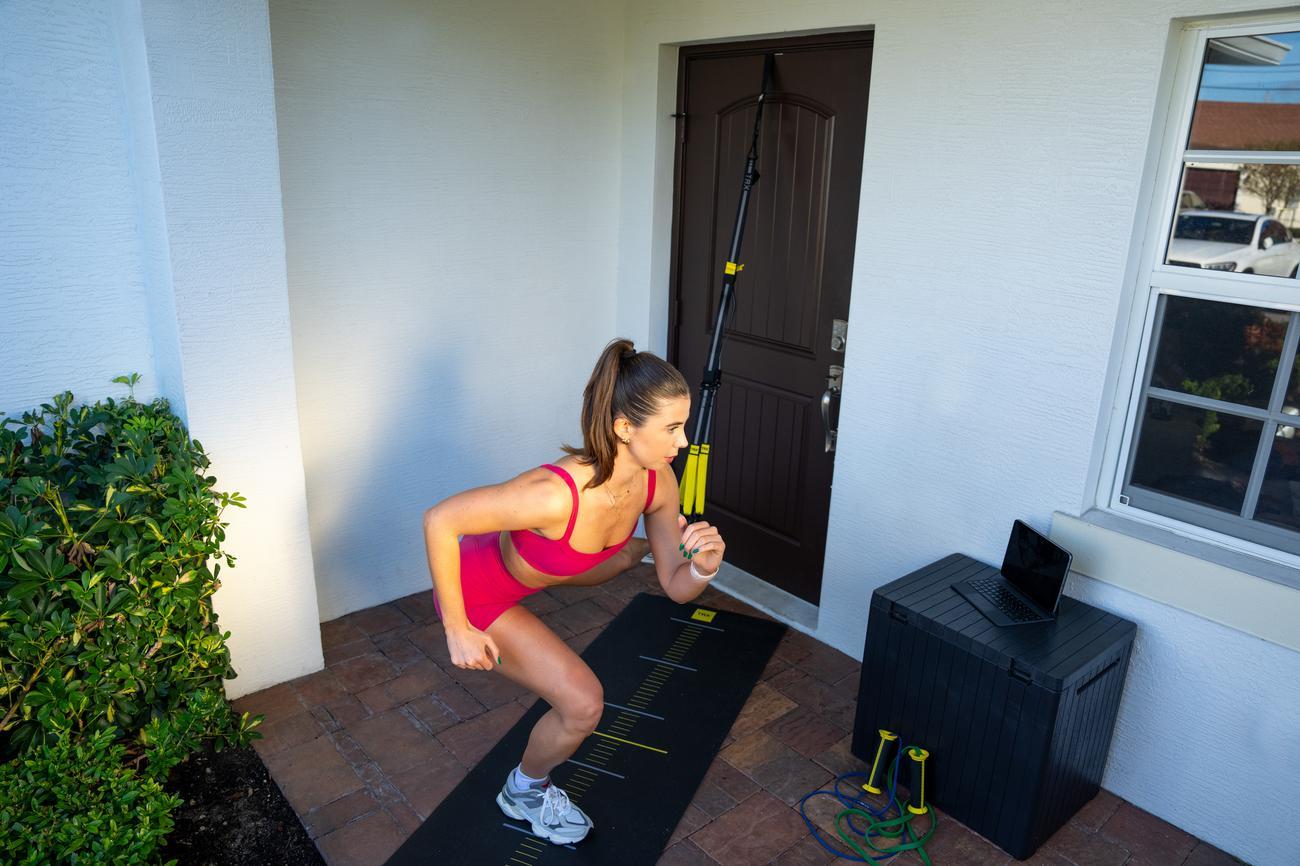
Anchor your Suspension Trainer overhead. Stand facing the anchor and hold the handles at chest height with light tension. Step your right foot back into a lunge position, lower until your back knee taps close to the ground, then drive through your front heel to stand back up. Do 6 to 8 reps per leg for 2 sets.
Keep your front knee tracking over your toes. Progress by pulling less on the handles until your legs are carrying the load.
Building Your Weekly Functional Fitness Routine
These functional training exercises for seniors fit into three sessions of 25 to 35 minutes each, enough to hit CDC guidelines and cover every category above. Here is a simple three-day at-home split you can run this week.
-
Day 1. Warm-up (moves 1 to 3) plus Lower Body (moves 4 to 7). Rest 60 to 90 seconds between sets.
-
Day 2. Warm-up (moves 1 to 3) plus Upper Body (moves 8 to 10). Rest 60 to 90 seconds between sets.
-
Day 3. Warm-up (moves 1 to 3) plus Core and Balance (moves 11 to 14). Rest 30 to 60 seconds between sets.
Space the sessions with at least one easier day in between. Across the week, you cover the full body functional exercises for seniors need most: mobility, strength, and balance. On off days, walk. Aim for daily movement. A 10-minute loop around the block counts.
If following your own routine sounds like more work than the workout itself, the TRX Training Club™ app has follow-along low-impact sessions built for exactly this kind of at-home training. Hit play and follow a coach instead of running it solo.
Frequently Asked Questions
What are the 6 functional exercises for seniors?
The six universal functional patterns are squat (sit-to-stand), hinge (glute bridge), push (wall push-up), pull (row), carry (farmer's carry), and balance (single-leg stand). Training all six is what makes a routine true functional fitness instead of isolated. This guide covers all six patterns plus mobility and rotation work. CDC guidance recommends strengthening the major muscle groups at least two days per week, and these six patterns cover that requirement.
What is the number one exercise for seniors?
Sit-to-stand. It maps directly to daily life (getting up from a chair, toilet, or couch), builds the leg strength that predicts long-term independence, and requires zero equipment. No single move covers everything, though, which is why this guide delivers 14.
How often should seniors do functional exercises at home?
Aim for three to five days per week with sessions of 20 to 35 minutes. Beginners can start with two days per week and build up as stamina improves. Space strength days with at least one easier day between them so muscles have time to adapt.
What should a 70 year old be doing every day?
Some form of daily movement is the base. Walking, mobility work, or a short chair-based session on non-training days keeps the tank full. Add structured strength and balance work two to three days per week per CDC guidance. And break up long stretches of sitting throughout the day, which turns out to be a stronger predictor of decline than any single workout you skip.
Move Better Every Day With TRX
Functional exercises for seniors are pattern-based training. They map to the life you live. That is exactly what TRX has been built on for over 20 years under one simple mission. Move better, grow stronger, live longer.
Here is your homework. The best functional exercises for seniors are the ones you actually do, so pick three moves from this list that feel most useful to your day tomorrow. Try them in the morning. Add a fourth next week. Keep the momentum small and repeatable, and stack it into the three-day split above once you feel ready.
When you are ready to add a low-impact tool, the TRX Suspension Trainer pairs cleanly with these exercises for assisted strength and balance work you cannot get with bodyweight alone. And the TRX Training Club app has follow-along sessions built around this exact style of training. TRX has certified over 300,000 trainers worldwide teaching this method. You are in good company.