
You've seen the HYROX hype. Maybe you've run one yourself, or you've watched the Instagram reels of people grinding through sled pushes and wall balls in a convention center somewhere. HYROX has earned its spot as the biggest name in hybrid fitness racing.
But if you're searching for HYROX alternatives, you've probably already picked up on what a lot of athletes are realizing. The fitness race world is way bigger than a single brand.
Some of these races cost $40. Others run past $2,000. Some take 35 minutes. One takes 24 hours. The right pick depends on what you actually want out of race day, not just what's trending.
Why Fitness Racing Is Blowing Up (And Why HYROX Isn't Your Only Option)
Hybrid fitness events are pulling in athletes who got bored with pure running races and people who love training but never had a competitive outlet for it. HYROX sits at the center of that movement, and for good reason. A 2025 study published in Frontiers in Physiology found that HYROX demands over 80% of race time at very-high cardiovascular intensity, with VO2max serving as the single strongest predictor of performance. That's a serious test of fitness.
But serious doesn't mean it's the only option. The functional fitness competition space now covers beach team throwdowns, military-style rucking events, partner races you can finish on a lunch break, and solo workouts you can do in your garage with basic cross-training equipment. If ATHX is on your radar, our list of ATHX alternatives covers ten more hybrid competitions worth training for. Some formats are indoor and timed. Others are outdoor and completely self-paced. Some cost nothing. Others run past a thousand dollars per team.
For each race below, you'll get the format, approximate cost, difficulty level, whether it's solo or team-based, and a straight answer on who it's actually built for.
How to Pick the Right Race for You
Budget is the obvious starting point. Some of these fitness races cost less than a decent pair of training shoes. Others require splitting a team entry fee that runs into four figures.
Solo versus team changes the experience completely. Racing alone tests your individual grit. Racing with a partner or a team of six adds accountability, strategy, and a different kind of energy altogether.
Then there's the skill question. Some races reward pure cardio and basic strength. Others demand rope climbs, rucking under load, or agility training exercises that test how fast you can change direction under fatigue. And travel commitment varies wildly. A few of these events run in hundreds of cities worldwide. Others happen once a year in a single location. The list below starts with the most accessible, affordable options and works toward the more specialized events.
1. TRX Ignite
If you want a fitness race that tests real functional strength without draining your bank account or requiring months of specialized prep, this is the one to start with.
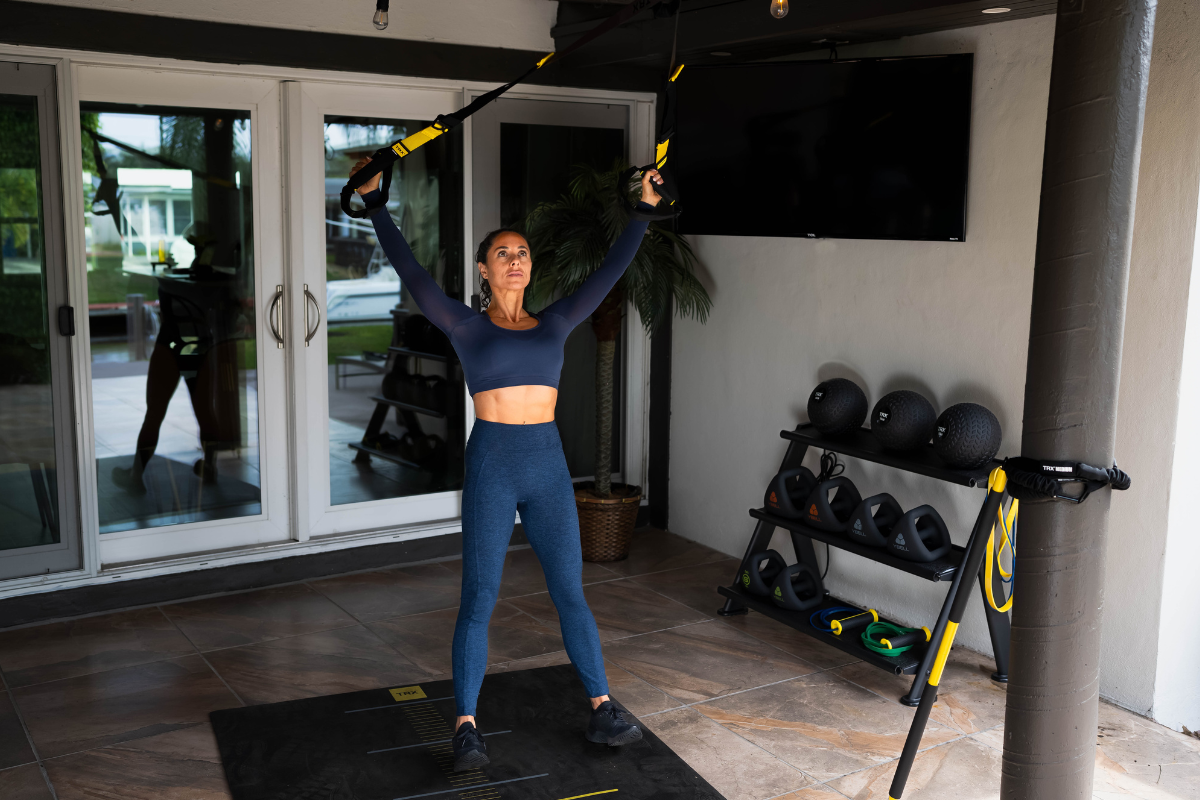
TRX Ignite is a 10-station timed race built around partner teams. Most pairs finish in 35 to 45 minutes, and entry is $40 per person. The format moves you through a full-body gauntlet using TRX's own equipment, including the Suspension Trainer™, YBells, Power Bags, and slam balls.
Here's what race day looks like. You and your partner rotate through:
-
500m Run
-
TRX Atomic Push-Ups
-
Slam Ball Broad Jumps
-
Power Bag Drags
-
YBell Reverse Lunges
-
1km Row
-
Power Cleans
-
YBell Squat to Overhead Press
-
Another 500m Run
-
TRX Low Rows
Every station hits a different movement pattern. Nothing gets neglected.
The partner format isn't just a gimmick. Built-in accountability changes how hard you push, and splitting the work means you can go all-out on each station knowing you'll get brief recovery while your partner works.
TRX was founded by Randy Hetrick, a Navy SEAL who built the first Suspension Trainer out of parachute webbing and a jiu-jitsu belt. That military background shows up in the race design, which is functional and efficient with zero wasted movement. And the training tools behind the race have solid research backing. An ACE-sponsored study found that an 8-week TRX training program significantly improved cardiovascular health markers, including reduced resting blood pressure, in participants.
Ideal for: People who want a structured, affordable race that tests full-body functional fitness without requiring obstacle-specific skills or a massive time commitment.
2. DEKA Fit
Think of DEKA as Spartan's indoor answer to HYROX, but with more options for how you race. If you've already been following a HYROX training program, DEKA's format will feel familiar. The two events get compared constantly, and the real split between Hyrox and Deka Fit comes down to running volume and race length.
DEKA runs through 10 functional fitness zones mixed with running segments. DEKA FIT pairs 5K of running with all 10 zones. DEKA MILE shortens the runs but keeps the same zones. DEKA STRONG drops the running entirely. You can also do DEKA at affiliated gyms on your own schedule, which makes it one of the most accessible competition formats going. Entry costs $103 to $125 per person.
The format is the closest thing to HYROX on this list, but events tend to be shorter and faster-paced. Zones include movements like rowing, ball slams, box jump-overs, and farmer carries. The tier system means you can start with STRONG if running isn't your thing and work your way up.
Spartan runs DEKA events at gyms across the country, so finding one nearby is straightforward. Times are tracked on a global leaderboard.
Ideal for: HYROX fans who want a similar indoor format with a shorter time commitment, or people who want the option to skip the running entirely.
3. Spartan Race
The original obstacle course race that brought fitness competitions to the mainstream. Spartan offers outdoor events at multiple distances. Sprint covers 3 to 5 miles with 20+ obstacles. Super runs 8 to 10 miles with 25+ obstacles. Beast pushes 12 to 14 miles with 30 to 35 obstacles. Ultra takes it past 30 miles with 60+ obstacles. Entry runs $80 to $150+ depending on distance and heat time.
What sets Spartan apart is the 30-burpee penalty for every failed obstacle. Can't get over the wall? That's 30 burpees before you keep moving. This rule means obstacle skills actually matter, not just your ability to run between them.
Courses use natural terrain (hills, water, woods) and the difficulty scales sharply between distances. Competitive heats are timed and ranked. Open heats are more relaxed but still follow the same penalty rules. Training for Spartan rewards speed and explosive movement work just as much as raw endurance, since the transitions between obstacles are where most athletes gain or lose time. That balance sets it apart from traditional distance events like the marathon, where success depends almost entirely on sustained aerobic output.
Ideal for: Runners who want an obstacle and strength element layered onto their endurance base, and competitive outdoor athletes who thrive on unpredictable courses.
4. Tough Mudder
Tough Mudder occupies a different corner of the obstacle race world. Standard events are not timed, which changes the entire atmosphere. This is a team-focused experience built around shared suffering and iconic obstacles like Electroshock Therapy (live wires), Everest (a quarter-pipe you need teammates to pull you over), Arctic Enema (an ice water plunge), and Funky Monkey (monkey bars suspended over water).
Events come in 5K and 15K distances, with entry between $100 and $120. The course design actively encourages helping strangers. Some obstacles are borderline impossible alone.
No clock means no pressure to rush past people or skip helping someone stuck on a wall. The vibe leans closer to a festival than a race, with beer at the finish line and a culture that treats completion as the whole point.
Ideal for: Groups of friends who want a physically challenging team experience without clock pressure or competitive rankings.
5. CrossFit Open
The most accessible competitive fitness event in the world, and quite possibly the cheapest. The CrossFit Open runs three workouts over three weeks. You do each workout at your local gym (or your garage), record your score, and submit it to a global leaderboard. Registration is $20. If you're weighing the differences between CrossFit vs. functional training, the Open is a useful lens for understanding where CrossFit's programming priorities land.
Each workout has three difficulty levels, so beginners and elite athletes participate in the same event with scaled options. Movements vary year to year but draw from barbell lifts, gymnastics skills, bodyweight movements, and cardio elements. Building a solid aerobic base with dedicated cardio training equipment before the Open can make the difference between finishing a workout and hitting the time cap.
Close to 300,000 athletes competed in the 2024 Open. For the top finishers, it's the gateway to CrossFit Quarterfinals and eventually the CrossFit Games. Plenty of Open athletes also eye a Hyrox season, and how Hyrox and CrossFit compare comes down to format, scoring, and pace. For everyone else, it's a once-a-year benchmark against a global field with zero travel required.
Ideal for: CrossFit gym members or anyone who wants to test themselves against a worldwide field without leaving their home city.
6. GORUCK
GORUCK makes fitness racing uncomfortable on purpose. These are military-style endurance challenges led by Special Forces cadre (actual former Green Berets and other special operations veterans). You carry a weighted rucksack (20 to 30+ pounds) for the entire event, and the cadre decides what you do.
Events come in escalating tiers. Light runs 4 to 5 hours. Tough runs 12 hours overnight. Heavy pushes past 24 hours with minimal sleep. There are no individual rankings. The entire class finishes together or not at all. Cadre assign team tasks like carrying logs, buddy carries, moving simulated casualties, and completing objectives under time pressure.
GORUCK attracts military veterans, first responders, endurance junkies, and civilians who want to test mental toughness rather than speed. The post-event bond between teammates is the real payoff. You won't PR anything, but you'll remember it.
Best suited for: People who value mental toughness and team bonding over speed and personal rankings.
7. Ragnar Relay
Ragnar takes the relay race concept and stretches it across two days and one night. Road events cover 200 miles with 12 runners per team. Trail events cover 120 miles with 8 runners.
Each athlete runs 3 separate legs of 5 to 8+ miles each, with rest periods in between while teammates cover their legs. Those per-leg distances overlap with half marathon training runs, which makes Ragnar a popular crossover for distance runners.
Teams travel together in vans, leapfrogging between exchange points around the clock. Someone on your team is always running, even at 3 AM. Total team entry runs $1,300 to $2,000+, which splits to $100 to $165 per person.
The experience sits somewhere between an endurance race and a road trip, with a healthy dose of sleep deprivation mixed in. Ragnar events run in dozens of locations across the US and internationally. If you've ever wanted to test your legs at 2 AM on a dark mountain road while your teammates sleep in a van, this is your race.
Ideal for: Running groups who want an adventure-style endurance event that bonds a team over a full weekend.
8. The Murph Challenge
Named for Navy Lieutenant Michael Murphy, who was killed in Afghanistan in 2005, The Murph Challenge happens every Memorial Day. The workout is a 1-mile run, 100 pull-ups, 200 push-ups, 300 air squats, and another 1-mile run. Many athletes wear a 20-pound vest.
You can do it at any gym, any park, any backyard, any pull-up bar. Official registration is $20 (all proceeds go to the LT. Michael P. Murphy Memorial Scholarship Foundation, which has raised over $2.25 million), but plenty of people just do the workout on their own for free.
There's no official timing system, no course, no fancy equipment, no obstacles. Just you and a brutally simple workout that honors a fallen service member. Thousands of gyms, military bases, firehouses, and community groups host Murph events simultaneously. The shared purpose makes it hit different than any competitive race on this list.
Ideal for: Anyone who wants a meaningful, low-cost physical challenge they can do at their own gym with zero travel.
9. Tribal Clash
A two-day beach competition for teams of 6 (3 men, 3 women). Tribal Clash keeps workouts secret until race morning, so you can't game the programming. Events use implements like logs, atlas stones, sandbags, and ocean swimming. Entry is $165 per person.
The atmosphere blends competition with beach festival. Events take place primarily in the UK and Portugal, and the programming favors well-rounded teams over specialists. You need people who can lift heavy, run, swim, and work together under pressure. There's no room for a team of six endurance runners or six powerlifters. Versatility wins.
Ideal for: CrossFit-style teams who want an international, festival-atmosphere competition on the beach.
10. Strong Viking
Europe's answer to accessible obstacle course racing. Strong Viking runs outdoor OCR events primarily in the Netherlands and Belgium, with distances at every level, including a 4km intro course and a 60km Ultra at the extreme end.
What makes Strong Viking stand out is the self-paced format. Obstacles are optional. You can skip anything beyond your current ability without penalty, which makes it one of the most beginner-friendly obstacle races running right now. But the upper tiers (42km Iron Viking, 60km Ultra Viking) are genuinely punishing. The self-pacing just means you choose your own level of suffering.
Best suited for: European athletes who want a flexible, self-paced OCR where they control the difficulty.
Find the Race That Fits Your Training
Ten races, each with its own format, cost, vibe, and level of suffering. The options are out there, and one of them fits the way you train.
Whether you're building a hybrid athlete training program that blends running and strength or you specialize in one discipline, having a race on the calendar gives your training a deadline and a purpose. And the training payoff is real regardless of which event you pick. A 2025 review in the Journal of Functional Morphology and Kinesiology found that high-intensity functional training produces 8 to 15% increases in VO2max and 10 to 20% improvements in strength measures.
If you're looking for a starting point that's accessible, affordable, partner-based, and built around functional movements with real research behind them, TRX Ignite checks every box. Forty dollars, 10 stations, and a finish time you'll want to beat next round.
Explore upcoming TRX Ignite events and find a race near you.