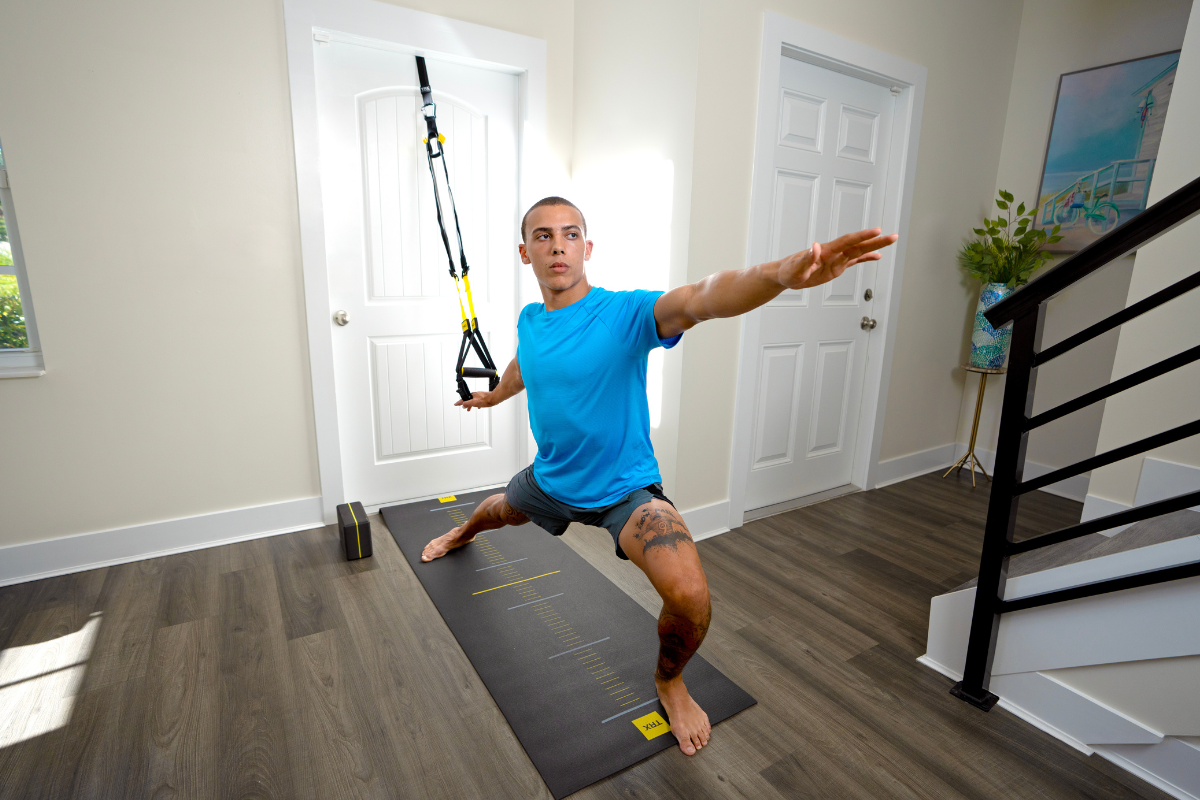

"Yes, you can get a full-body, effective workout at home in just 10 minutes."
Even a 10-minute session delivers results when paired with effective bodyweight HIIT gear designed for high-intensity circuits.
In this guide, you'll get a quick warm-up, a full 10-minute circuit, easy and advanced modifications, TRX upgrades, and simple form tips so you feel confident.
Ready to move? Keep reading, and let's start your 10-minute workout at home for free time.
Why a 10-Minute At-Home Workout Works
Ten minutes is enough time to raise your heart rate, breathe harder, and wake up your muscles.
Scientists use something called METs to measure how much energy you burn. When you go from sitting to moving, your MET level climbs, your body uses more fuel, and your joints get real mobility work instead of staying stiff.
Short workouts also make it easier to stay consistent, which matters more than having one long workout once in a while. These quick 10 minute workouts can boost your energy, support your metabolism, improve posture, build strength, and lift your mood. Even a brief beginner at home workout creates positive momentum.
You can drop this routine into tiny "free-time" pockets: on a lunch break, before work, or in that short quiet time at night when you might usually scroll your phone. The beauty of a 10 minute beginners workout is that it never feels overwhelming, yet results add up quickly.
Who Does This Workout Work For?
This routine is great for busy professionals who jump from meeting to meeting, students who live on weird schedules, parents who grab minutes between kid chaos, and anyone coming back to exercise after a long break.
If the idea of a full gym session feels too big, a beginner home workout like this will feel doable and clear. It removes all barriers: no commute, no crowds, no judgment, and no expensive memberships.
It also works if you have a tiny living space, sensitive joints that need low-impact cardio exercises, or zero gear. The moves are kind to your knees and back, and you can do them on a small patch of floor.
No commute, no crowd, just you and gravity working together. This beginner at home workout meets you exactly where you are.
What Will You Need? (Minimal Equipment + Optional TRX Enhancements)
You can do this whole beginner home workout with only your body weight and a bit of floor space. If all you have is a clean spot on the ground and a phone to keep time, you are fully set.
TRX is not required. It only shows up if you want to level up later.
Optional gear that can help:
-
Exercise mat or folded towel
-
Small towel for sweat
-
TRX Suspension Trainer (totally optional)
-
Water bottle
-
Timer or phone with a stopwatch
TRX as an Awesome Optional Upgrade
TRX is a pair of straps that attaches to a door or a strong anchor. It works well in tight spaces because you stay mostly in one spot and use your own body weight.
You can make exercises easier or harder just by stepping your feet closer or farther away, so the difficulty is very easy to control. Your core has to stay active the whole time to keep you steady.
You can place your feet in the straps to turn a regular plank into a much harder core move. Push-ups get tougher when your hands or feet are in the handles, but the time stays the same.
Squats can turn into TRX-assisted squats or jump squats, where the straps help you balance while your legs do more work. For those interested in expanding equipment options, explore resistance band leg exercises or exercise bands for added variety.
But First, the Warm-Up (2 Minutes)
Your warm-up only needs two minutes to wake up your joints and muscles. You will do four simple moves for about 20 to 30 seconds each.
The goal is to loosen your hips, shoulders, and spine while getting your blood flowing, not to tire yourself out before the main circuit.
Try this quick warm-up:
-
March in place: Lift your knees to hip height and swing your arms naturally
-
Hip circles: Stand with feet hip-width apart and make slow circles in both directions
-
Shoulder rolls: Roll your shoulders backward 10 times, then forward 10 times
-
Torso twists: Stand tall with feet planted and rotate your upper body side to side
Repeat any move that feels good until you hit about two minutes.
Some Extra Warm-Up Instructions
Move slowly and with control. Keep your shoulders relaxed, knees soft, and feet planted in a steady stance. Breathe in through your nose and out through your mouth while you move.
Avoid sharp or bouncing motions and keep your range of motion comfortable, not forced. A short warm-up raises your muscle temperature and improves blood flow, which helps your body react better to each exercise.
This can lower your risk of strains and make your workout feel smoother and stronger. Two quiet minutes here can make your ten active minutes feel much better.
10-Minute Workout: Full-Body Circuit
Set a timer for 10 minutes and choose one pattern for the whole workout. You can use either 40 seconds of exercise with 20 seconds of rest, or 30 seconds of exercise with 15 seconds to switch moves.
Follow these steps:
-
Pick your work and rest pattern
-
Set your timer for 10 minutes with those intervals
-
When the timer says go, start your exercise
-
When it beeps for rest, stop or slow down and breathe
-
Repeat until the 10 minutes are done
Your job is simple. Keep breathing, keep moving, and let the clock handle the timing. All exercises should be quiet, low-impact, and friendly to small spaces so you can train in a bedroom, dorm, or living room without jumping around.
Think smooth steps, controlled squats, and steady floor work that respect your joints. The circuit is built for beginners, people coming back to exercise, and anyone who wants real work without noise or drama.
Here Are Some Core Exercises You Can Include
Start with simple moves that work your whole body. Use this step-by-step plan:
-
Choose 5 to 7 exercises from this list: bodyweight squats, reverse lunges or step backs, incline push-ups, wall push-ups, marching plank, bird dog, dead bug, low impact jacks, or slow high knees.
-
Arrange them in any order that feels simple to remember.
-
Set your timer for your work and rest times.
-
Rotate through your chosen exercises until the 10 minutes are done.
For form, think "stacked and steady." Keep your knees tracking over your toes, not caving in. Keep your spine neutral, so your back stays straight, not rounded or arched hard.
Brace your core like you are about to cough so your ribs and hips stay lined up. In push positions, place your hands under your shoulders, look a little ahead, and keep every move smooth instead of jerky.
If you're dealing with sensitive knees, check out these exercises that help with runner's knee for additional joint-friendly modifications.
Sample Exercise Breakdown
Bodyweight Squats: Stand with feet hip to shoulder-width apart. Sit back like you're reaching for a chair, keeping your chest up and weight in your heels. Push through your heels to stand back up.
Reverse Lunges: Step one foot back, lower your back knee toward the floor while keeping your front shin vertical. Push through your front heel to return to standing. Alternate legs each rep.
Incline Push-Ups: Place your hands on a sturdy elevated surface. Keep your body in a straight line, lower your chest toward the surface with control, then push back up.
Marching Plank: Hold a plank position. Slowly lift one knee toward your chest, hold briefly, then return it to the floor. Alternate sides while keeping your hips level.
Bird Dog: Start on hands and knees. Extend your right arm forward and left leg back simultaneously. Hold briefly, return to start, then switch sides.
Dead Bug: Lie on your back with arms extended toward the ceiling and knees bent at 90 degrees. Slowly lower your right arm overhead while extending your left leg. Return to start and alternate sides.
For those looking to add upper body work, explore bicep bodyweight exercises or shoulder workouts at home to complement this routine.
Do You Need to Worry About Levels? Variations: Beginner, Intermediate, Advanced
Pick one level for today so you feel challenged but not wrecked. You should breathe harder and feel your muscles working, but still be able to speak short sentences.
If you finish the 10 minutes and feel bored, move up a level next time. If you feel dizzy or your form falls apart, drop down a level and shorten your work time.
Beginner: This 10 minute beginners workout uses 30 seconds of work and 15 seconds of rest, with higher surfaces for push-ups and smaller squat depth. Focus on learning the movement patterns correctly.
Intermediate: Shift to 40 seconds of work and 20 seconds rest, using full squats, reverse lunges, and regular incline push-ups. Your breathing should be noticeably harder while maintaining clean form.
Advanced: Stay at 40 seconds but add TRX options, deeper ranges, and fewer breaks between moves, while still keeping control and clean posture.
You can also mix levels within the same workout—maybe you do advanced squats but beginner push-ups if your upper body needs more development.
The Final Cool Down (1–2 Minutes)
After the last exercise, do not just stop and sit. Use 1 to 2 minutes to bring your heart rate down and tell your nervous system that the workout is over. This helps blood flow return to normal and may reduce that heavy, jittery feeling your muscles sometimes get after effort.
Stand tall and take slow breaths while you gently stretch the muscles you just used. Walk in place, then add light calf stretches, a soft quad stretch while holding a wall, and a slow forward fold with loose knees.
Roll your shoulders, let your arms hang, and relax your jaw. Keep the moves smooth, never jerky, and stay in ranges that feel good.
Extra Tips for Staying Consistent and Some Common Mistakes to Avoid
Set a simple rule for yourself, like doing this workout right after brushing your teeth or before you open any social apps. Pairing it with a habit your brain already knows makes it easier to repeat.
Keep your mat out where you can see it, use a short playlist or single song as your timer, and track your sessions on a calendar so you can see streaks grow. Tiny visual wins matter a lot.
If maintaining a regular fitness routine helps with stress management, you'll find that fitness routines can support anxiety relief in meaningful ways.
Common Mistakes to Avoid
Racing through reps so fast that your form collapses. Slow down and focus on control.
Skipping the warm-up because you feel rushed. Those two minutes significantly reduce injury risk.
Holding your breath when things get hard. Breathe continuously—exhale during the hardest part of each exercise.
Pushing through sharp pain in the knees or lower back instead of adjusting the move. If something feels sharp or wrong, change the angle, make the range smaller, or swap the exercise.
Consistency plus good form will always beat ego speed. Understanding the difference between quantity versus quality in physical training can help you make smarter decisions.
The Final Breakdown: You Can Do It!
Before, squeezing in a workout might have felt impossible: too busy, too tired, or too much effort to leave the house.
But now you've got a simple 10-minute routine you can do anytime, with or without equipment, that still hits your whole body. This beginner home workout removes every excuse.
Stick with these quick 10 minute workouts daily or a few times a week and you'll build strength, boost your mood, and feel more in control of your day. Remember: 10 minutes is enough to change your energy for the whole day. Choose YOU for those 10 minutes!
As you progress, explore related training methods like multiplanar training or try TRX Pilates workouts for core-focused sessions.
The hardest part is simply starting. Once you complete your first session, the second becomes easier, and before you know it, this 10-minute workout at home for free time becomes a natural part of your daily routine.
References
American College of Sports Medicine. "ACSM's Guidelines for Exercise Testing and Prescription." ACSM, www.acsm.org. Accessed 6 Dec. 2025.
Centers for Disease Control and Prevention. "Physical Activity Basics." CDC.gov, U.S. Department of Health & Human Services, www.cdc.gov/physicalactivity/basics/index.htm. Accessed 6 Dec. 2025.