
Functional training exercises build the kind of strength you use every day: hauling groceries up the stairs, picking up your kid mid-tantrum, getting off the floor without the sound effects. This guide breaks down 17 moves organized by movement pattern, with bodyweight, free-weight, and TRX Suspension Trainer™ options so you can start wherever you are.
How Functional Training Works
Functional training exercises are multi-joint, multi-planar movements that prepare your body for the real-world tasks you do every day. Think lifting groceries, climbing stairs, carrying kids, swinging a golf club, and getting up off the floor. Instead of isolating one muscle at a time, these compound functional movements train the patterns your body uses, which builds strength that carries straight into the rest of your life.
That principle shaped TRX from day one. Founder Randy Hetrick built the first Suspension Trainer™ from a jiu-jitsu belt and parachute webbing while deployed as a Navy SEAL, because he needed a way to train his whole body anywhere, with almost nothing. The mission hasn't changed since. Move better, grow stronger, live longer.
This is different from isolated strength training, which targets one muscle in one plane, and different from HIIT, which prioritizes cardiovascular intensity. Functional training is strength work first, with a heavy bias toward movements you'd use outside the gym. In a grappling gym that carryover is literal, where single-arm rows and rotational core work map onto guard passing and takedown defense.
Quick medical note. Check with a physician before starting a new routine, especially if you have a history of injury or any chronic condition.
Take Our Training Quiz Today
The 7 Foundational Movement Patterns
Human movement breaks down into seven foundational patterns. Push, pull, squat, hinge, lunge, carry, and rotate. Anti-extension and anti-rotation core work sits underneath all of them, holding the rest of the body in position so the patterns can happen safely.
Every exercise in this guide maps to one of those seven patterns. Train all of them and you cover the way your body is built to move. Skip a few and you build a body with blind spots, which is how nagging injuries and weak links start showing up.
According to Harvard Health Publishing, functional fitness focuses on training muscles to handle the demands of daily life. That is exactly what these seven patterns do.
The 17 Functional Fitness Exercises
The list below is organized by movement pattern, with bodyweight, dumbbell, kettlebell, and TRX Suspension Trainer™ options so any reader can find a version that fits their setup. Each move pairs well with the functional training equipment you already own. Pick the version of these functional training exercises that matches your current strength, not the version that looks the most impressive.
1. Bodyweight Squat
The squat is the most-used movement in daily life. You squat to sit down, stand up, pick something off the floor, and get in and out of the car. Train it well and the rest of your day gets easier.
Stand with feet shoulder-width apart, weight in the midfoot. Brace your core, push your hips back and down, and bend your knees so they track over your toes. Chest tall, ribcage stacked over your hips, and drive through the floor to stand back up.
Watch for knees collapsing inward. Fix it by actively pushing them out as you descend.
2. Goblet Squat
The goblet squat loads the front of your body, which teaches you to keep an upright torso and braces the core under tension. It's the cleanest bridge between bodyweight squats and barbell work, and it builds full-body strength fast.
Hold a dumbbell or a TRX YBell at your chest with both hands, elbows tucked in close. Squat to depth with the same form as a bodyweight squat. Hips back, knees out, chest tall. Drive through the midfoot to stand.
The YBell works well here because it gives you a comfortable grip without the awkward weight shift of a single dumbbell.
3. TRX Suspension Trainer™ Assisted Squat
If you have limited mobility, knee discomfort, or you're brand new to squatting, this version teaches the pattern without overloading it. The TRX Suspension Trainer™ offloads some of your bodyweight and lets you nail the depth and the path.
Anchor the strap overhead, hold the handles at chest height, and step back until the straps are taut. Sit your hips back and down, keeping your chest tall, then drive through your midfoot to stand.
Use the straps for balance and support, not to pull yourself up. Your legs do the work.
4. Push-Up
The push-up is the original horizontal push. It trains the chest, shoulders, triceps, and core all at once, which is why it has been around forever and isn't going anywhere.
Set your hands under your shoulders, body in a straight line from head to heels, and brace your core. Elbows track at roughly 45 degrees from your sides as you lower your chest to the floor, then press back up to full extension.
Too hard? Drop your hands to a bench for an incline push-up. Too easy? Put your hands in the Suspension Trainer™ handles and let the instability cook your shoulders.
5. TRX Suspension Trainer™ Chest Press
Pushing while stabilizing against unstable straps recruits significantly more core than a flat-bench press. Your shoulders, chest, and abs are all working at the same time, which is exactly what real-world pushing looks like.
Face away from the anchor, handles at chest height, palms facing the floor. Lean forward into the push-up plane until your arms are extended, then bend your elbows and lower your chest toward your hands. Press back to lockout.
Steeper lean equals harder rep. Scapular control matters more than the lean angle, so own the position before you turn up the difficulty.
6. Bent-Over Dumbbell Row
Most adults sit and look down all day. The bent-over row is the antidote. A horizontal pull that builds the posterior chain and counters everything your desk job does to your posture. For the hours between training sessions, a few exercises for desk workers help undo that same slumping.
Hold a dumbbell in each hand, hinge forward at the hips with soft knees and a neutral spine. Adjustable dumbbell gym equipment lets you scale the load as you build strength. Let the dumbbells hang straight down. Pull them to your ribcage with your elbows tight to your sides, then control the way back down.
If you feel your lower back rounding, shorten the range, re-brace the core, and only lift weight you can move with a flat spine.
7. TRX Suspension Trainer™ Row
This is the most scalable pulling exercise in fitness. Adjust your foot position and you can dial the difficulty from "first day in the gym" to "I've been training for ten years."
Face the anchor, hold the handles with palms facing each other, and walk your feet forward until your body is at an angle. Brace your core into a plank. Pull your chest to the handles by driving your elbows back and squeezing your shoulder blades together, then control the way back down.
Suspension-style pulling tends to build strength, balance, and functional capacity faster than the same row done on a bench, because the unstable straps recruit your whole midline on every rep. Put another way, the Suspension Trainer™ row is doing more work than it looks like.
8. Renegade Row
The renegade row stacks an anti-rotation core challenge on top of a pulling pattern. One side rows while the other side keeps you from twisting toward the floor, which is closer to how real-world strength plays out.
Set up in a high plank position with a dumbbell in each hand, feet wider than hip-width for stability. Row one dumbbell to your ribs while keeping your hips square to the floor, then lower it under control and row the other side.
Real-world strength rarely happens with both feet planted and both hands free. This exercise teaches your body to produce force while staying stable.
9. Romanian Deadlift (RDL)
The hip hinge is the single most useful movement for protecting your lower back when you pick something up. Train it once and the way you bend over to grab a suitcase or a kid changes for the better.
Hold a dumbbell or kettlebell in each hand in front of your thighs, knees soft. Hinge back at the hips, sliding the weights close to your legs as you go. Keep a neutral spine the entire time. When you feel a stretch in your hamstrings, drive your hips forward to stand back up.
You should feel the stretch in your hamstrings, not your lower back. If your back is doing the work, you're squatting, not hinging.
10. Kettlebell Swing
The swing turns the hip hinge into an explosive pattern. It builds posterior-chain power that translates directly to running, jumping, sprinting, and picking heavy things up off the floor.
Stand with a kettlebell about a foot in front of you, feet just outside hip-width. Hinge forward, hike the bell back between your legs, then snap your hips forward to let the bell float to chest height. Let gravity do the return trip and absorb the load with your hips, not your lower back.
Heads up. People constantly turn the swing into a squat. The hips power the bell, not the knees.
11. Walking Lunge
The lunge is single-leg strength and balance that translates straight into walking, hiking, climbing stairs, and chasing kids around the yard. Most adults lose unilateral strength as they age, and the walking lunge is one of the best ways to keep it.
Take a long step forward with one leg. Lower your back knee toward the floor without slamming it down, keeping your front shin roughly vertical. Drive through your front heel to step the back leg through into the next lunge.
Want to load it up? Hold a dumbbell or a YBell in the goblet position at your chest. The added load makes your core work harder, too. Loaded lunges are where leg gym equipment earns its keep.
12. TRX Suspension Trainer™ Single-Leg Lunge
This one is brutal in the best way. You get unilateral strength, balance, and and hip mobility in a single move, and your rear leg has nowhere to hide.
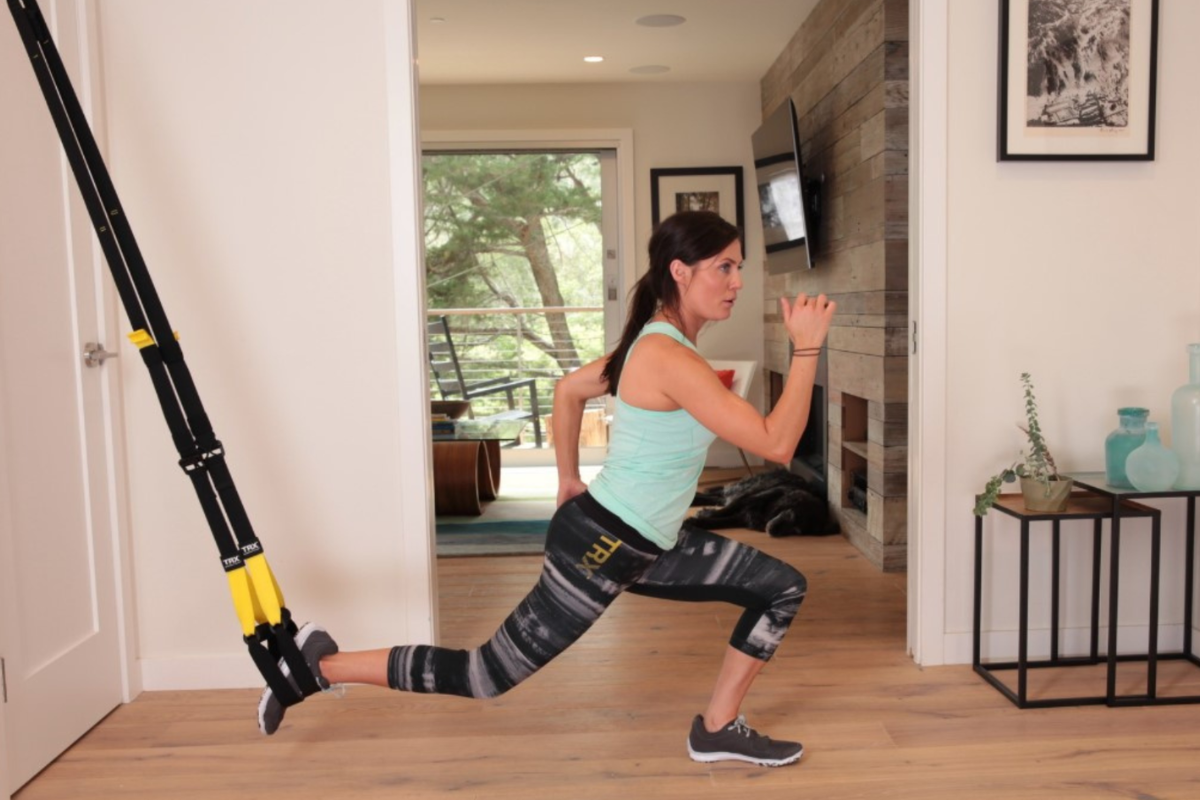
Anchor the Suspension Trainer™ and hook one foot into the foot cradle behind you. Hop the front foot forward into a split stance. Lunge straight down by bending the front knee, keeping the chest tall, then drive through the front heel to stand.
Most adults lose single-leg strength before they lose anything else. This exercise trains it directly and doesn't let you cheat with the other leg.
13. Lateral Lunge
Almost every strength program ignores side-to-side movement, which is wild because that is where most non-contact injuries happen. The lateral lunge trains the frontal plane, builds hip strength, and improves your ability to change direction.
Stand tall, then take a wide step out to one side. Sit into that hip by bending the knee and pushing your hips back, keeping the opposite leg straight. Both toes stay pointed forward. Drive off the working leg to return to standing.
Keep your chest up, knee tracking over the working foot, and both feet flat on the floor through the rep.
14. Farmer's Carry
The farmer's carry is the simplest, most underrated functional move you can do. Grip strength, core stability, posture, and total-body endurance, all from picking up something heavy and walking.
Pick up a heavy dumbbell or kettlebell in each hand. Stand tall with shoulders pulled back and ribcage stacked over your hips. Walk for distance or time, keeping the chest up and core braced the entire way.
The same Harvard research noted above flags grip strength as a marker of overall health and longevity, which is one of the reasons strong, easy carries show up in everything from training rooms to assessments for healthy aging. Train it now with the right grip training equipment and your future self will thank you.
15. TRX RIP Trainer™ Rotational Chop
Most strength programs train you in straight lines and skip rotation entirely. The TRX RIP Trainer™ fills that gap with asymmetrical loading that mirrors real life. Golf swings, throwing, twisting to reach behind you in the car.
Anchor the resistance cord and grip the bar with one hand on each end. Stagger your stance with the working side away from the anchor. Drive through the back hip and chop the bar across your body, keeping your arms long and your core braced.
This one shows up in golf, baseball, tennis, and lacrosse training for a reason. Rotational power is hard to build with traditional dumbbells.
16. Plank
The plank is anti-extension core strength, which is a fancy way of saying it trains the muscles that keep your spine from caving under load. That stability is the foundation for every other exercise on this list, and the right abs training equipment helps you scale once bodyweight planks feel easy.
Set your forearms under your shoulders, elbows bent at 90 degrees. Step your feet back so your body forms a straight line from head to heels. Squeeze your glutes, brace your core, and tuck your ribcage down toward your hips.
Thirty seconds of a strict plank beats two minutes of a sagging plank. Quality over time, every time.
17. TRX Suspension Trainer™ Mountain Climber
This is the closer. It hits your core, your shoulders, and your cardiovascular system in one move, and the unstable straps force every stabilizer to wake up.
Anchor the Suspension Trainer™ and hook both feet into the foot cradles. Set up in a high plank position with your hands directly under your shoulders. Drive one knee at a time toward your chest, keeping your hips level and your core tight.
Speed it up for a conditioning finisher. Slow it down for strict core control. Both work.

How to Build These Exercises Into a Routine
You don't need to do all 17 every week. A simple three-day functional split covers every pattern and leaves room for recovery. Athletes who want more volume and dedicated muscle-group days can organize these movements into a five-day training split instead.
-
Day 1 trains push, pull, and squat.
-
Day 2 trains hinge, lunge, and carry.
-
Day 3 hits rotation and a full-body finisher.
Pull 5 to 6 exercises per session from the list above, three sets of 8 to 12 reps for strength work, 30 to 45 minutes total. The right strength training equipment lets you progress the load as you adapt. Research from the National Institutes of Health supports training functional strength 2 to 3 times per week as the minimum for noticeable gains in strength and independence as you age.
If you want guided TRX functional training without thinking about it, the TRX Training Club™ app builds the workouts for you with the equipment you already own.
Functional Training Benefits
Functional training carries real, measurable benefits, and the best functional fitness workouts deliver results that go beyond what isolated lifting can offer. That real-world carryover is also what makes functional training the foundation for hybrid fitness competitions that test strength and endurance in the same event. Deka Fit and Hyrox are two of the most popular of those events, and choosing between Deka Fit and Hyrox comes down to how much running you want on race day.
-
Real-world strength carryover. Train the patterns you use outside the gym and they get easier.
-
Improved balance and reduced fall risk. The same research on functional training shows meaningful gains in balance, which matters more every year you age.
-
Joint resilience. Multi-planar work builds stability in directions traditional lifting ignores.
-
Time-efficient training. Compound movements train more muscle in less time, which is a gift for anyone trying to fit a real session into a real schedule.
-
Scalability for any level. Bodyweight regressions and loaded progressions mean any room you have is the right room.
-
Long-term independence. Functional fitness keeps people strong, mobile, and independent as they age, which is why functional exercises for seniors consistently show up at the top of healthy-aging training recommendations.
This is what the TRX mission points at. Move better, grow stronger, live longer, and back it up with movement that transfers.
Common Mistakes to Avoid
A few quick traps that derail more functional training programs than anything else.
-
Skipping the warm-up and mobility prep. Loaded patterns need a primed nervous system. Five minutes of dynamic prep beats five months of nagging injuries.
-
Loading the pattern before you own the bodyweight version. If you can't do a clean bodyweight squat, the goblet squat won't fix you. It will hide the issue.
-
Training only sagittal-plane work. Forward and back is half the picture. Skip lateral and rotational training and your body will let you know eventually.
-
Treating functional training as cardio. Strength first, conditioning second. If you turn every session into a sweat-fest, you stop building strength.
Frequently Asked Questions
What are the 7 main functional movements?
Push, pull, squat, hinge, lunge, carry, and rotate. Every exercise in this guide maps to one of these patterns, and together they cover the way the human body is built to move.
What is a functional training exercise?
Any movement that trains your body for real-life tasks across multiple joints and planes of motion. Instead of isolating one muscle, it trains patterns like squatting, hinging, or carrying that you use outside the gym.
How often should I do functional training?
Three to four sessions per week is the sweet spot for most adults. That same NIH research on functional strength and aging supports 2 to 3 sessions per week as the minimum for meaningful gains in strength, balance, and independence.
Can beginners do functional training?
Yes. The TRX Suspension Trainer™ is the single best entry point because it scales to any fitness level. Adjust your foot position and the same exercise can challenge a first-timer or a Navy SEAL.
Start Your Functional Training Routine With TRX
Push, pull, squat, hinge, lunge, carry, rotate. Seven patterns, 17 functional training exercises, every fitness level. Pick five from the list this week and you have built your first functional session.
If you want a tool that scales with you, the TRX Suspension Trainer™ shows up in five of these movements and travels in a bag. If you want the workouts built for you, the TRX Training Club™ app does the planning so you can focus on the work.
Move better. Grow stronger. Live longer. That's the whole point.
Sources
"Functional Fitness." Harvard Health Publishing, Harvard Medical School, https://www.health.harvard.edu/exercise-and-fitness/Functional-fitness.