
You don't need a rack of dumbbells to build a demanding home strength routine. Good alternatives for weights at home create progressive resistance you can control through bodyweight, leverage, elastic tension, or a stable external load.
That leaves plenty of options beyond the cans in your pantry. The 17 tools below cover full-body work, compact external loads, pulling, rotation, and low-cost stand-ins. Each includes a way to progress and one setup limit.
Before starting a new exercise routine, consult your physician, especially if you have a health condition or current injury.
Key Takeaways: Alternatives for Weights at Home
-
The best alternatives for weights at home create progressive resistance through bodyweight, leverage, elastic tension, or a stable external load, so traditional dumbbells and barbells are optional for a well-rounded home routine.
-
Start with a suspension trainer, YBell, or resistance bands, then match the tool to your biggest movement gap, available anchor points, storage space, and preferred way to progress.
-
TRX Training's home gym equipment collection brings suspension systems, YBells, strength bands, and other compact tools into one place, which makes comparing a small-space setup easier.
-
Household objects can work for slow, controlled exercises, but purpose-built equipment is the better choice for swinging, dropping, overhead work, anchoring, or heavy loads.
How to Choose an Alternative to Weights at Home
Start with movement, not equipment. The best alternatives to weights at home should let you push, pull, squat, hinge, carry, and rotate.
One versatile tool may cover most of that list. A second tool should fill a real gap, not merely collect dust with excellent posture.
Match the resistance to your goal. A suspension trainer changes difficulty when you move your feet and alter your body angle.
Bands add more tension as they stretch. A YBell, sandbag, vest, or loaded backpack provides external load.
Bodyweight tools make familiar movements harder by changing stability, range, or limb position.
Check the practical details next, including storage space, anchor needs, grip demands, noise, floor protection, and how precisely you can increase the challenge. A compact tool is only useful if your room supports the movement. A quiet apartment setup has different needs than a garage.
None of these choices feels exactly like a barbell or dumbbell. That is fine.
Choose the resistance style you can use consistently, progress safely, and fit into your actual space. This home strength training guide can help you turn that choice into a complete routine.
Think about your progression ceiling, too. Beginners can make major gains with bodyweight and light tools because there are many new challenges available.
Experienced lifters may need heavier sandbags, multiple YBell sizes, stronger bands, or combined tools. Think past day one.
17 Fitness Equipment Alternatives for Weights at Home
The most useful weight alternatives for home workouts start with a suspension trainer, YBell, or resistance bands, then expand through bodyweight tools, specialty equipment, and controlled household stand-ins. Each option below includes a clear way to progress plus the setup limit most likely to matter at home.
1. TRX Suspension Trainer™
A suspension trainer earns the top spot because it turns your bodyweight into adjustable resistance for rows, presses, squats, lunges, hamstring curls, and core work. Move your feet closer to the anchor or change your body angle to increase the challenge. Slow the lowering phase, add a pause, or use one limb.
Randy Hetrick built the original system from parachute webbing and a jiu-jitsu belt while deployed, so the train-anywhere idea is baked in. Use a secure, rated anchor, inspect the straps before training, and keep the floor clear.
For movement ideas, explore this TRX exercise guide. Start with a body angle that lets you keep tension without losing alignment from head to heel.
2. TRX YBell
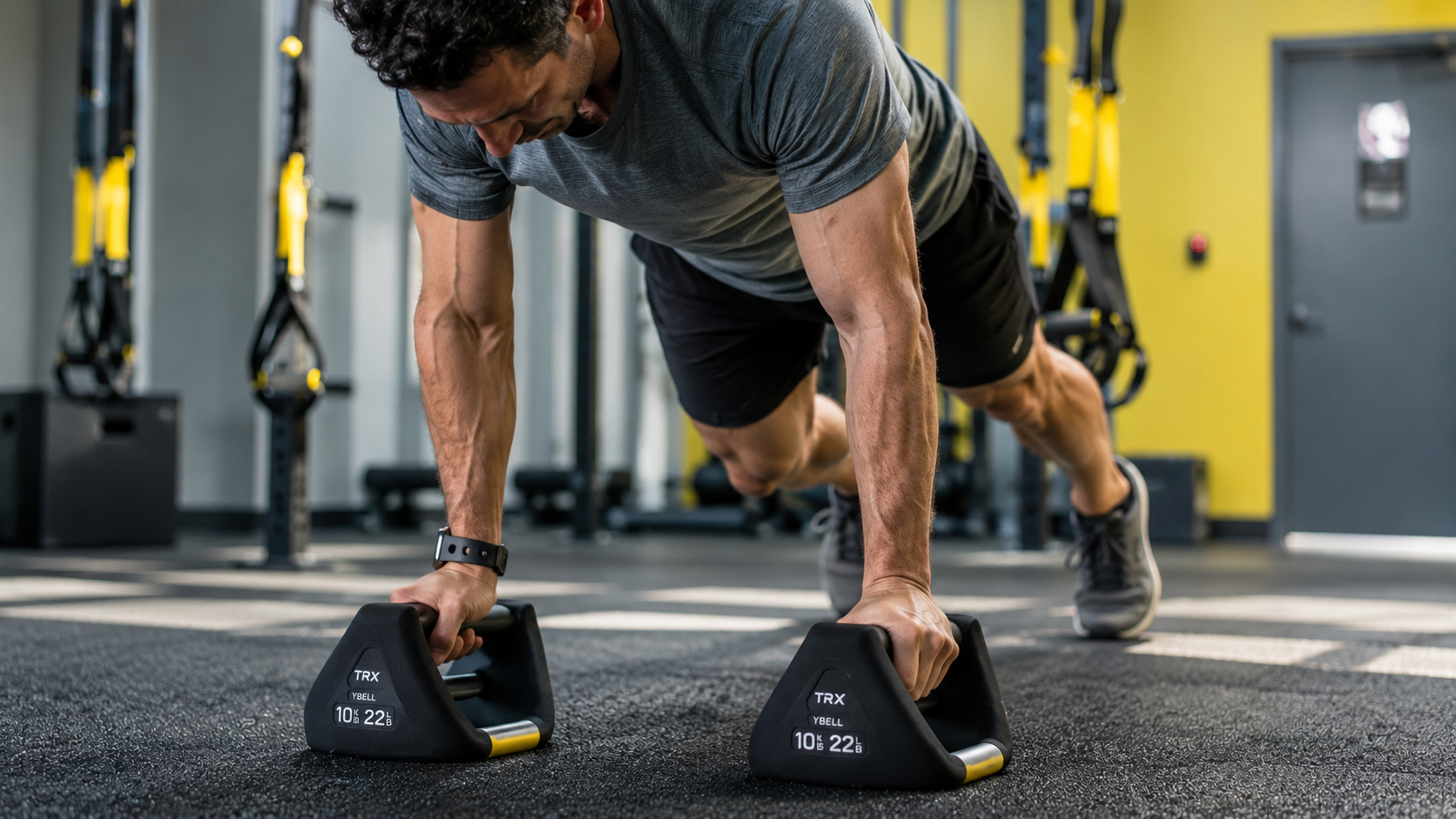
The TRX YBell gives you a dumbbell, kettlebell, dual-grip medicine ball, and push-up stand in one compact tool. Grip changes let you move quickly between goblet squats, rows, presses, carries, swings, and elevated push-ups without covering the room in equipment.
Go heavier when you're ready. Or use more reps, range, tempo, or single-side work.
Set it down with control and keep your wrist stacked over your forearm during presses. Each YBell has a fixed load, so stronger users may eventually need more than one size.
For swings, clear the path first. Use a load you can decelerate without the tool pulling you forward.
3. Resistance Bands
When comparing resistance bands vs weights, remember that full-length strength bands can handle rows, presses, squats, deadlifts, pull-throughs, and chops. Smaller loop bands work well for lateral steps, glute work, and controlled lower-body drills. Bands get tougher as they stretch.
A 2019 systematic review and meta-analysis found that elastic and conventional resistance training produced similar strength gains across the included studies. Increase band thickness, stretch distance, range, tempo, or paired bands to progress.
Inspect the band and anchor before every set, and use this resistance band exercise guide for more movement options. Never stretch a band beyond its intended range or place your face in the recoil path.
4. Bodyweight Training
Squats, split squats, push-ups, pike presses, bridges, planks, and controlled single-leg work can build a strong base with zero equipment. Make them harder with a longer range, slower lowering, pauses, added reps, or tougher leverage. This six-week bodyweight program offers a ready-made progression.
The main gap is pulling. Without straps, rings, or a bar, it is difficult to train rows and vertical pulls.
Precise load increases get tricky once high-rep variations become more tiring than useful. A door-anchored strap or pull-up bar closes that gap.
5. Gymnastics Rings
Rings pack small and open up rows, pull-ups, push-ups, dips, support holds, and core work. Those moving handles demand control. Begin with feet-supported rows or elevated push-ups before trying advanced suspended positions.
Need more from the rings? Change your body angle, lower the handles, extend your legs, slow the rep, or add range. Hang both straps at equal length from a rated overhead anchor with enough clearance.
Rings demand more control from beginners. If the rings or anchor make noise or shift, stop and reset before the next rep.
6. Sandbag
Among alternatives to dumbbells, a sandbag brings an intentionally awkward, shifting load to deadlifts, bear-hug squats, lunges, carries, shouldering, and floor presses. That instability makes a modest load feel honest. Add filler, extend carries, insert pauses, or choose a heavier bag to progress.
Keep the bag close to your torso while learning, and check every closure and handle before lifting. Protect the floor if the filler is dense.
Sandbags are versatile, but load changes are less exact than plates or adjustable dumbbells. Choose a bag with handles that let your wrist stay neutral instead of folding under the load.
7. Medicine Ball or Slam Ball
Medicine balls suit controlled squats, presses, carries, and throws. Slam balls absorb repeated impact.
Do not assume every medicine ball belongs in an overhead slam. Check the product rating and use a compatible wall or floor.
To make the drill harder, adjust the load, throw distance, speed, or carefully managed volume. Wait for the ball to settle.
Balls add power and variety, but they cannot replace heavy pulling or precise load increases. Use a ball designed for the exact job, because a bouncing medicine ball can rebound unpredictably during slams.
8. Weighted Vest
A weighted vest adds hands-free resistance to squats, lunges, step-ups, push-ups, crawls, and walking-based conditioning. Fit matters. The vest should stay snug and centered instead of bouncing or shifting as you move.
Start light. Then add load, reps, time, or range in small steps. Stop if the weight changes the movement pattern you intended to train.
A vest leaves grip work untouched. Distribute removable weights evenly so one side does not tug the vest out of position.
9. TRX Rip Trainer™
The TRX Rip Trainer™ is a specialized substitute for weights at home when rotation is the priority. It adds rotational and asymmetrical resistance.
Its weighted bar and anchored cord support chops, standing presses, rows, rotations, and anti-rotation holds. Adjust your stance, move farther from the anchor, use a stronger cord, or slow the return to progress.
Use a secure anchor and keep the full arc clear of people and furniture. This tool is portable and purpose-built for rotation, but it needs a reliable anchor and does not replace heavy bilateral leg work. Face the cord's pull with a stable stance before adding speed or a larger range.
10. Battle Ropes
Battle ropes are better for conditioning and muscular endurance than for replacing heavy strength work. Alternating waves, double waves, slams, and controlled pulls challenge your upper body and trunk while your legs hold position.
Make the interval longer, use more rope, drop into a lower stance, or try a more complex pattern. You need a solid anchor, plenty of floor length, and neighbors who tolerate some thump.
Lower-body loading remains limited. Keep the rope pattern crisp, and end the interval before fatigue turns every wave into a full-body flail.
11. Pull-Up Bar
A pull-up bar is one of the most focused home workout equipment alternatives because it fixes a common home-gym gap. Use it for hangs, pull-ups, chin-ups, and feet-assisted or band-assisted progressions. Build difficulty with slower lowering, pauses, extra reps, or eventually a securely attached load.
The bar and mounting surface must support your bodyweight and the forces of the movement. Don't drop into a loose hang.
Pair the bar with a pushing and lower-body option for a more complete program. Test the installation according to the manufacturer's directions before hanging your full bodyweight.
12. Sliders
Sliders turn lunges, hamstring curls, mountain climbers, body saws, and push-up variations into serious control work. Towels can work on smooth floors.
Paper plates may slide on carpet. Test friction before committing to a full set.
Want a tougher rep? Increase the range, slow the tempo, use one limb, or lengthen the lever.
Sliders are cheap and compact, but they challenge leverage and control rather than providing heavy external load. Use them to load the supporting side through leverage and control.
13. Stability Ball
A stability ball adds range and an unstable surface to hamstring curls, wall squats, rollouts, bridges, and elevated push-up variations. Choose the correct size, inflate it as directed, and train on a clean surface with enough room for an unexpected roll.
New to the wobble? Start near a wall and choose a simple movement while you find your balance. Earn more range slowly.
The ball adds variety and stability demands, not heavy progressive loading. A softer ball or slippery floor can change the exercise quickly, so check both before loading the movement.
14. Ankle and Wrist Weights
Wearable weights provide modest resistance for controlled leg raises, marching drills, arm work, and selected Pilates-style movements. Use small increases and keep every rep smooth. If the load pulls a joint out of position, it is too much for that movement.
Avoid fast swings, hard impact, or treating light wearables like a heavy-strength solution. Use them for targeted resistance. Remove them before unrelated exercises instead of leaving them strapped on.
15. Loaded Backpack
Among household items to use as weights, a sturdy backpack can add load to squats, split squats, step-ups, good mornings, push-ups, carries, and controlled rows using a strong handle. Pack soft items around denser objects, balance the contents, cinch every strap, and wear the bag high and snug.
Build the load gradually. Inspect the seams, zippers, and handles before you lift.
Skip improvised swings. Shifting contents and household hardware are not built for ballistic work. A scale helps you track the load instead of guessing from whatever happens to fit inside.
16. Water Jugs or Bottles
Sealed water jugs offer handles and adjustable mass for curls, rows, carries, squats, lunges, and controlled presses. Smaller bottles suit lighter arm work. Larger jugs make carries and lower-body movements more demanding.
Match both sides when symmetry matters, and check caps, handles, and condensation before lifting. Avoid fast or overhead movements with fragile, open, or damaged containers.
The National Center on Health, Physical Activity and Disability lists bottles and jugs among practical home exercise loads. Leave room inside the jug for a secure cap seal, and dry the handle before every set.
17. Bags of Rice, Pet Food, or Canned Goods
Secure bags work for bear-hug squats and carries. Cans can add light resistance to curls or raises. Put breakable packaging inside a stronger tote, keep the load close, and choose movements without fast direction changes.
These household options are temporary budget tools with imprecise progression. Purpose-built equipment makes more sense when you need dependable grip, durability, overhead work, or heavier loading. A tote with intact handles makes loose cans easier to control, but it still belongs in slow, grounded movements.
Why Does a YBell Work Well in a Small Home Gym?
For compact home gym equipment, the TRX YBell® NEO saves floor space by combining a dumbbell, kettlebell, dual-grip medicine ball, and push-up stand in one stackable tool.
That makes it useful when you want external load for squats, rows, presses, carries, swings, and push-ups but do not have room for four equipment types.
Choose one load for the movements you train most, then add a second size only when your reps outgrow it. A YBell still has a fixed load, so it saves space but does not replace every weight increment.
Match the Tool to Your Training Goal
Pick the smallest setup that covers your biggest movement gaps. The table below compares all 17 options by best use, resistance style, space, progression, and the limitation most likely to matter.
|
Tool |
Best use |
Resistance type |
Space |
Progression |
Key limitation |
|
Suspension trainer |
Full-body portable training |
Bodyweight and leverage |
Small, with anchor |
Angle, stance, tempo |
Needs secure anchor |
|
YBell |
Compact loaded strength |
Fixed external load |
Small |
Load, reps, range |
Each unit has fixed load |
|
Resistance bands |
Travel and variable tension |
Elastic tension |
Minimal |
Band, stretch, tempo |
Tension changes by range |
|
Bodyweight |
No-equipment foundation |
Bodyweight and leverage |
Small |
Leverage, range, volume |
Pulling is harder |
|
Rings |
Upper-body pulling and support |
Bodyweight and instability |
Small, with overhead anchor |
Angle, range, tempo |
Steeper learning curve |
|
Sandbag |
Carries and lower-body loading |
Shifting external load |
Medium |
Filler, carries, pauses |
Imprecise load changes |
|
Medicine or slam ball |
Throws, slams, and carries |
Fixed external load |
Medium |
Load, speed, distance |
Limited pulling |
|
Weighted vest |
Hands-free loading |
Distributed external load |
Small |
Load, time, range |
No grip or pulling work |
|
Rip Trainer |
Rotation and anti-rotation |
Anchored elastic tension |
Medium, with anchor |
Stance, distance, cord |
Needs clear movement arc |
|
Battle ropes |
Conditioning and endurance |
Rope mass and momentum |
Large |
Intervals, rope, stance |
Limited leg loading |
|
Pull-up bar |
Vertical pulling |
Bodyweight |
Small, with mount |
Assistance, tempo, reps |
Needs companion tools |
|
Sliders |
Control and leverage |
Bodyweight and friction |
Minimal |
Range, tempo, lever |
No heavy external load |
|
Stability ball |
Range and stability work |
Bodyweight and instability |
Medium |
Range, tempo, lever |
Not for heavy loading |
|
Ankle or wrist weights |
Light targeted resistance |
Wearable external load |
Minimal |
Small load increments |
Limited load ceiling |
|
Loaded backpack |
Budget squats and carries |
Improvised external load |
Small |
Load, reps, range |
Hardware can fail |
|
Water jugs or bottles |
Controlled budget lifting |
Improvised external load |
Small |
Water volume, reps |
Grip and leakage risk |
|
Bags or cans |
Temporary budget loading |
Improvised external load |
Small |
Contents, reps, tempo |
Awkward, imprecise load |
How to Progress Without Traditional Weights
Progressive overload without weights means making a movement gradually more demanding while your technique stays controlled. The 2026 American College of Sports Medicine position stand supports progressive resistance training and notes that several variables can be adjusted to improve muscle function and performance.
Change one thing at a time. Add resistance, reps, sets, range, a slower tempo, longer pauses, harder leverage, single-side work, shorter rest, or longer carries. One clean change tells you what made the exercise harder.
Write down the details that matter for your tool, including anchor height, foot position, band color, bag load, reps, range, and tempo. When no number is printed on a dumbbell, consistent setup notes become your measuring tape.
Combine tools when one stops challenging a movement. Add a band to a squat, wear a vest for push-ups, or use sliders for hamstring work after loaded hinges. Keep the combination simple enough that you can repeat the same setup and compare your performance.
How Do You Progress Suspension Training Without Heavier Weights?
TRX Suspension Trainer™ exercises get harder when you change body angle, balance demands, or tempo instead of adding plates.
Use a simple ladder. Steepen the angle, slow the lowering phase, pause at the hardest point, narrow your stance, then try a single-limb variation. Change one variable and record the anchor height, foot position, and tempo.
This progression ladder helps one tool cover more stages of strength work without changing equipment. It does not copy the feel of a heavy barbell, so keep external load in your plan when maximum-strength work is the goal.
Safety Checks for At-Home Weight Alternatives
Inspect straps, bands, bags, handles, anchors, bars, balls, and containers before every session. Clear the area. Purpose-built equipment is the better option for dropping, swinging, anchoring, overhead work, or heavy loads.
Keep improvised loads controlled. Do not swing fragile containers, lift leaking jugs, trust unstable furniture, or hang from an unrated doorframe. Choose resistance and range you can control, and stop if you feel pain or notice equipment starting to fail.
Set the room before the first rep. Confirm the floor is dry, the path is clear, and every anchor or mounting point is closed and stable. If children or pets can enter the space, choose a setup you can stop safely without dropping or releasing the load.
Frequently Asked Questions
These answers cover muscle growth, dumbbell substitutes, resistance bands, and household safety so you can choose a practical starting point without guessing.
Can You Build Muscle Without Traditional Weights?
Yes. Bodyweight strength training at home can build muscle if the exercise creates enough resistance and becomes harder over time. Bands, suspension training, and stable external loads can also provide that challenge. Stronger users may need heavier gear later.
What Can I Use Instead of Dumbbells at Home?
Good substitutes include a suspension trainer, YBell, resistance bands, sandbag, weighted vest, rings, loaded backpack, or sealed water jugs. Use straps or bands for pulling, a YBell or sandbag for loaded squats and carries, and bodyweight for pushing and leg work.
Are Resistance Bands as Effective as Weights?
Bands can produce similar strength gains when effort and progression are appropriate, based on the meta-analysis cited above. The feel is different because band tension changes through the range.
A free weight supplies a more constant external load. Pick the tool you can progress consistently.
What Is the Safest Household Substitute for Weights?
There is no universal safest object. Favor sealed, intact items with a secure handle and a load you can control. A well-packed backpack or water bottle can work for slow exercises, but purpose-built gear is the safer call for swinging, dropping, anchoring, overhead work, or high loads.
Build Your Home Strength Setup With the Right Weight Alternatives
For strength training without weights, start with one versatile primary tool. Add a second only when it fills a clear movement or progression gap. A suspension trainer covers portable full-body work, a YBell adds compact external load, and resistance bands bring travel-friendly variable tension.
The best alternatives for weights at home are the ones you can set up, control, and progress week after week. Start with the tool that matches your space and preferred resistance style, then use this at-home full-body workout to put it to work.
Ready to build yours? Compare TRX Training equipment by function and sport, choose the tool that closes your biggest movement gap, and start with one full-body routine you can repeat. Pick your first tool and put it to work this week.