
Start with the TRX YBell® when you want a flexible kettlebell alternative, then compare the other kettlebell alternatives by the training quality you need most. Dumbbells, sandbags, resistance bands, suspension trainers, medicine balls, barbells, rotational trainers, weighted vests, and loaded backpacks can all cover parts of the job. Pick yours by whether you need load, explosive power, portability, grip work, or rotational resistance.
A useful kettlebell substitute doesn't have to resemble a bell. It has to load the movement you want to train without turning the setup into a wrestling match. Once that feels solid, build the challenge with more load, reps, range of motion, slower tempo, or tougher leverage.
Key Takeaways: Choosing Kettlebell Alternatives
-
The best kettlebell alternative depends on the movement pattern and loading style you need, so judge each option by the job it must perform.
-
TRX YBell gives the broadest one-tool coverage in this list because changing grips lets it function as a kettlebell, dumbbell, dual-grip medicine ball, or push-up stand.
-
Choose by movement pattern first. Match the substitute to the squat, hinge, push, pull, carry, rotation, or power demand you want to preserve instead of judging it by shape alone.
-
Progressive resistance training matters more than chasing one perfect implement, so increase one variable at a time and keep the load, setup, and technique under control.
What Makes a Good Kettlebell Alternative?
A good kettlebell replacement preserves the movement pattern you care about. A kettlebell hangs an offset load beneath its handle. You feel that design immediately during swings, cleans, snatches, carries, and rack work because the bell travels around the hand instead of staying centered inside it. A balanced dumbbell can train many of the same muscles, though fast transitions feel different.
Run a potential replacement through the main patterns. Can you squat, hinge, push, pull, carry, and rotate with it? Ballistic power deserves a separate check, especially when the float and timing of a swing matter to you. General strength gives you much more room to improvise.
That flexibility is good news. The 2026 ACSM resistance training position stand found that equipment type did not consistently determine training outcomes. Progressive resistance training mattered more. In plain English, the tool is only useful if you can challenge yourself with it consistently and with solid technique.
These kettlebell alternative exercises make more sense when you start with the patterns a bell can cover. For a closer look at those patterns, read TRX's guide to a complete full-body kettlebell workout. Then use the options below to preserve the parts that matter most to your program.
10 Best Kettlebell Alternatives for Full-Body Strength
The ranking below favors useful training over a perfect visual match. A few options feel familiar as soon as you pick them up. Others solve the same problem with a completely different kind of resistance.
1. TRX YBell
The TRX YBell takes the top spot because one compact weight can serve as a kettlebell, dumbbell, dual-grip medicine ball, or push-up stand. Change your grip and you can move from a swing to a press or a floor exercise without building a small equipment museum in your workout space.
Grab the outer handle for kettlebell-style swings and goblet squats. On a swing, push your hips back, keep the weight close through the backswing, and drive the floor away as your hips extend. Deadlifts and carries call for long arms and ribs stacked over your hips. Move to the center handle for rows and presses, then set the frame flat before using it as a push-up stand.
An alternative to kettlebells still needs a clear progression path. A heavier YBell raises the load. You can add clean reps, slow the lowering phase, or progress from two-sided work to one side at a time. Each YBell has a fixed weight, so stronger movements may eventually call for a second size.
2. Dumbbells
Dumbbells make an easy transition into presses, rows, lunges, squats, step-ups, and carries. Their balanced shape behaves predictably, which is handy when you're learning a movement. Adjustable models let you progress without lining an entire wall with weights.
Turn one dumbbell upright at your chest for a goblet squat, or hold one in each hand for lunges and Romanian deadlifts. When you row, hinge first and pull toward your ribs. Don't shrug the weight toward your ear. You can perform a two-hand vertical dumbbell swing, but use a lighter starting load because the grip and balance point won't match a kettlebell.
Dumbbells do not reproduce cleans and snatches one-for-one. The load stays closer to the handle, which changes the path and timing. TRX's kettlebells versus dumbbells guide explains why each shape earns a place in a strength program.
3. Sandbags
Sandbag strength training changes the challenge by making the load less predictable. Sandbags refuse to sit perfectly still. That shifting load turns cleans, bear-hug squats, shouldering, lunges, deadlifts, and carries into a bracing challenge. Useful? Absolutely, though a shifting load isn't automatically better than a stable one.
Pull the bag tight to your torso for a bear-hug squat, then sit down between your hips while your chest stays tall. To shoulder it, start from the floor, hinge to get your grip, extend your hips, and guide the bag to one shoulder. Keep your hips and shoulders turning together so your lower back doesn't take the twist. Before any carry, make sure the load is secure.
More filler or a heavier bag gives you a simple load increase. Longer carries and paused reps work, too. The trade-off is rougher weight adjustments and an awkward shape for strict overhead lifting. Sandbags shine when grip, bracing, and carries matter more than tiny load jumps.
4. Resistance Bands
Resistance band strength training is hard to beat in a suitcase or a cramped home gym. Rows, presses, squats, deadlifts, pull-throughs, and chops need almost no storage space. Band tension climbs as the material stretches, so each rep feels different from a free weight.
For a pull-through, anchor the band low behind you and walk forward until the slack disappears. Keep a soft bend in your knees, hinge, and drive your hips forward while your arms stay quiet. On rows and presses, line up the band with your intended path. Keep it away from sharp edges that can nick the material.
Need more resistance? Use a thicker band, move farther from the anchor, or slow the rep. Check for cracks, thin spots, and tears before you train. Bands can build plenty of strength, but they won't give you a free-swinging offset load.
5. TRX Suspension Trainer™
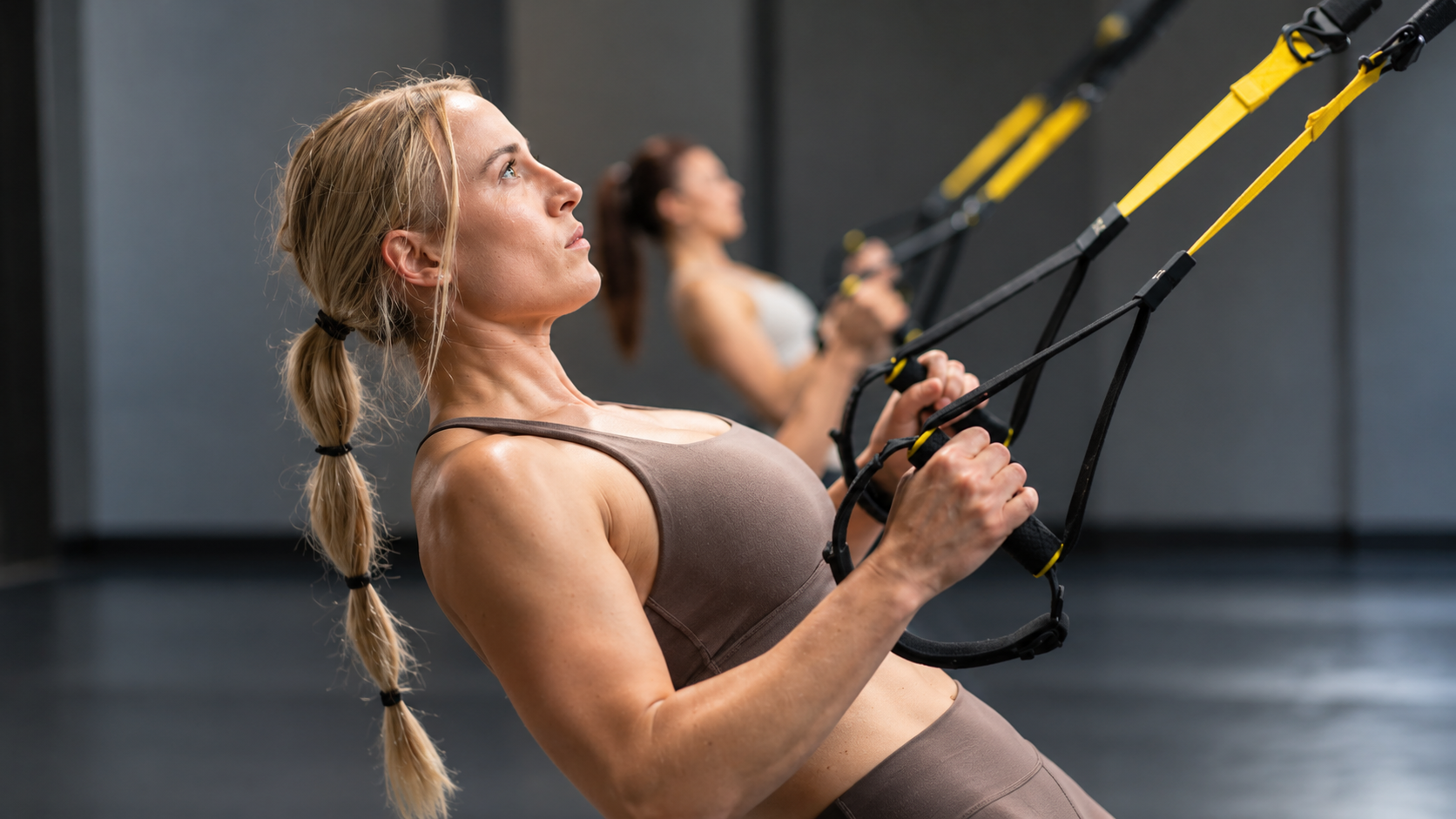
The TRX Suspension Trainer™ supports suspension training exercises built around bodyweight and leverage. It does not mimic a kettlebell. Instead, it covers pushing, pulling, squatting, lunging, hamstring work, and core control with a tool that packs down for travel.
For a TRX row, face the anchor with the straps tight and keep a straight line from head to heels. Pull your chest toward the handles, walking your feet closer to the anchor when you want more resistance. On the chest press, face away and brace as your body moves forward. During squats and reverse lunges, use the handles for balance instead of hauling yourself back up.
Progress with foot position, body angle, range, tempo, or single-limb variations. Always attach the straps to a strong, secure anchor that supports your body weight. These suspension training exercises pair well with loaded work, as TRX's guide to mixing suspension training with kettlebells shows.
6. Medicine Ball or Slam Ball
Medicine ball exercises and slam-ball drills cover the power and rotation found in many kettlebell sessions. A medicine ball works for squats, rotational throws, presses, and carries. Save overhead slams and controlled over-shoulder work for a slam ball, and make sure the floor can handle the impact.
Bring the ball overhead with your ribs down, extend through your hips, and drive it toward the floor ahead of your feet. If it rebounds, give it room. During a rotational throw, let your feet, hips, and upper back turn together. Wrenching the movement from your lower spine is a bad trade.
A heavier ball can raise the challenge. So can a faster throw, provided the movement stays sharp. Neither option is great for heavy presses or long carries. Check whether the ball is built to bounce, slam, or throw before you test it against the floor or a wall.
7. Barbell or Weight Plate
When you need full-body strength training equipment for heavy, measurable progression, the barbell wins this list. Deadlifts, front squats, presses, rows, and loaded carries let you add weight in small steps. Short on space? A single plate still handles goblet-style squats, lunges, halos, and controlled core work.
Set the bar over your midfoot before a deadlift, brace, and keep it close on the way up. With a plate squat, hold the plate firmly at chest height while your knees track with your toes. Halos need a lighter load. Move the plate slowly and keep it close to your head.
This setup needs more room and preparation than most options on the list. This setup lacks the fluid, offset feel of a kettlebell. Choose it when your priority is progressive strength, not fast transitions or swing-specific practice.
8. TRX Rip Trainer™
The TRX Rip Trainer™ is portable strength training equipment that covers a gap many basic setups miss. The anchored cord and weighted bar create rotational and asymmetrical resistance for chops, presses, rows, rotations, and anti-rotation holds. Your hips, core, shoulders, and balance all have to stay in the conversation.
Set the anchor to one side for a standing chop, take a stable staggered stance, and hold the bar with both hands. Turn through your feet, hips, and upper back while your midsection stays braced. On an anti-rotation press, square your hips and press forward. Resist the cord without tipping toward the anchor.
Walk farther from the anchor, change the cord resistance, or make the return slower. The Rip Trainer travels easily but still needs a solid anchor and clear space around the bar. Use it for focused rotational work rather than trying to force it into a swing.
9. Weighted Vest
A weighted vest is small-space strength equipment that makes squats, lunges, step-ups, push-ups, crawls, and walking tougher without occupying your hands. In a small space, that's a big advantage. You can keep familiar bodyweight patterns and add load without learning a new grip.
Tighten the vest so it doesn't bounce or wander. Keep your normal foot pressure during squats and step-ups, and stop if the vest pulls you out of position. On push-ups, brace from shoulders to heels. Raise your hands to an incline when a floor rep starts to sag.
Progress by adding a small amount of weight, reps, or time. A vest cannot reproduce swings, cleans, snatches, or hand-held grip work. Start conservatively, because the added load follows you through every rep.
10. Loaded Backpack
A loaded backpack is one of the most accessible kettlebell alternatives at home and a budget pick for controlled squats, split squats, step-ups, good mornings, carries, rows, and some presses. It works well on the road. It's a low-commitment way to test a home routine before you buy dedicated gear.
Cushion hard objects with soft items, cinch every strap, and inspect the seams and handles first. Wear the bag high and snug for squats or step-ups. For rows, grab a sturdy top handle, hinge, and pull toward your lower ribs. The contents shouldn't swing around while you move.
Add weight slowly and keep the bag balanced from side to side. Exact progression gets messy, and loose contents can shift halfway through a rep. Leave ballistic swings to equipment with a secure handle and a load designed to move that way.
What Does a YBell Replace in a Small Home Gym?
A TRX YBell can stand in for a kettlebell, dumbbell, dual-grip medicine ball, and push-up stand when floor space is tight. Its multi-grip frame changes the job without a trip back to the equipment rack. Use the outer handle for swings and goblet squats, the inner handle for rows and presses, and the flat frame for push-ups. It will not copy every kettlebell skill, but it can cover more movement patterns with one fixed-weight tool.
Best Kettlebell Alternative by Movement Pattern and Goal
For kettlebell swing alternatives, separate explosive hinge work from controlled hinge strength. Choose a kettlebell alternative by the training task it needs to cover. The chart pairs each goal with a strong first pick and a backup that covers much of the same ground.
Quick comparison
|
Goal or movement |
Best option |
Strong backup |
|
Broadest one-tool coverage |
TRX YBell |
Dumbbells |
|
Swing or explosive hinge |
TRX YBell |
Dumbbells |
|
Controlled hinge |
Barbell |
Dumbbells |
|
Squat |
TRX YBell |
Sandbag |
|
Push |
Dumbbells |
Resistance bands |
|
Pull |
TRX Suspension Trainer |
Dumbbells |
|
Carry |
Sandbag |
TRX YBell |
|
Rotation |
TRX Rip Trainer |
Medicine ball |
|
Travel |
Resistance bands |
Loaded backpack |
|
Small-space training |
TRX YBell |
Weighted vest |
|
Heavy progressive strength |
Barbell |
Dumbbells |
No implement wins every category. What matters is progressive challenge, sound technique, and enough consistency to let the work add up. TRX's functional fitness exercise guide can help you fill any missing push, pull, squat, hinge, carry, or rotation pattern.
Sample Full-Body Strength Circuit Without a Traditional Kettlebell
Use this five-move circuit to cover a hinge, squat, push, pull, and carry or rotation without a traditional kettlebell. A bodyweight strength workout can follow the same pattern with unloaded or suspension-based swaps. Always consult with your physician before undertaking a new exercise routine. Choose a load and range of motion you can control without pain or form breakdown. Complete two to three sets of eight to 10 controlled reps per exercise, resting as needed between movements.
Hinge: YBell Deadlift
Hold the YBell by the outer handle in front of your thighs. Soften your knees and send your hips back while the weight tracks close to your legs. Drive the floor away to stand tall. A dumbbell Romanian deadlift uses the same hinge when you need a swap.
Squat: YBell Goblet Squat
Cradle the YBell close to your chest. Sit down between your hips, keep your knees tracking with your toes, and press through your whole foot to stand. No YBell? Wear a loaded backpack high and snug.
Push: YBell Floor Press
Kettlebell substitute exercises should preserve the original movement goal even when the grip changes. Lie on your back with a YBell in each hand, or train one side at a time. Stack each wrist over its elbow, lower until your upper arm meets the floor, and press without peeling your ribs up. A securely anchored resistance band chest press gives you a portable swap.
Pull: YBell Bent-Over Row
Hinge forward and let the YBell hang beneath your shoulder. Pull it toward your ribs, pause, and lower it without rushing. For a bodyweight option, use a TRX row and adjust your feet until every rep stays clean.
Carry or Rotate: YBell Suitcase Carry
Stand tall with one YBell at your side and walk a controlled distance without leaning away from the load. Switch hands, then repeat. Want anchored rotational resistance instead? Use a Rip Trainer anti-rotation press.
Turn one dial at a time. Add a little load, a rep or two, more range, a slower lowering phase, or tougher leverage. If the new version scrambles your form, back off and own the easier one first.
Safety, Progression, and When a Kettlebell Still Makes Sense
Treat every home gym weight alternative as a setup check first. Give the setup a hard look before the first rep. Grips should feel stable, anchors secure, floor space clear, and bands, bags, and straps intact. Use a load you can control all the way through the set. Pain, a slipping grip, or a lost position means the set is over.
Progress doesn't require a total program overhaul. Pick one variable such as weight, reps, sets, range, tempo, leverage, or complexity. Give your body time to respond, and write down what you did. Next week's decision gets much easier.
A traditional kettlebell still makes the most sense when you want to practice technical swings, cleans, snatches, and rack work with an offset bell. An alternative can train the same muscles or outcome, but it cannot preserve every detail of the original movement.
Should You Choose a YBell or a Dumbbell?
Choose a TRX YBell for broader exercise variety from one compact weight, or use an adjustable dumbbell instead of a kettlebell when balanced loading and smaller weight jumps matter more. YBell changes jobs as you change grips, then sets flat for push-ups. An adjustable dumbbell keeps the feel more familiar for strict presses, rows, lunges, and squats. Let your program decide. Frequent swings and floor transitions favor YBell, but measured load increases may favor the dumbbell.
Frequently Asked Questions
These quick answers resolve the most common equipment, movement, and home-workout questions about kettlebell alternatives.
Can I Use a Dumbbell Instead of a Kettlebell?
Yes. A dumbbell works well for squats, presses, rows, lunges, carries, and many controlled lifts. You can perform a two-hand vertical dumbbell swing, but start lighter and expect a different grip and balance point. Cleans and snatches do not transfer one-for-one.
What Can I Do Instead of Kettlebell Swings?
A useful substitute for kettlebell swings depends on the quality you're chasing. Dumbbell swings and band pull-throughs keep the hinge. Romanian deadlifts and hip thrusts slow it down for controlled hip strength. Broad jumps and slam-ball work lean into explosive power. Every option gives something up.
Can Resistance Bands Build Full-Body Strength?
Yes, as long as the band creates enough tension and your training gets harder over time. Squats, rows, presses, deadlifts, pull-throughs, and chops cover the big movement patterns. Heavy lower-body work and small, exact resistance jumps become trickier as you get stronger.
What Household Item Can Replace a Kettlebell?
A loaded backpack or sturdy handled water jug can work for controlled squats, lunges, rows, carries, and presses. Secure the contents, inspect the handle or seams, and keep the movement smooth. Skip improvised ballistic swings with fragile containers or shifting loads.
Choose the Tool You Will Actually Use
The best kettlebell alternatives fit your goals, your space, and the way you actually like to train. YBell leads this list because its multiple grips cover loaded hinges, squats, presses, rows, carries, and floor work without a pile of separate equipment.
Start with the training gap you need to fill. Choose the TRX YBell for compact loaded strength, the Suspension Trainer for adjustable bodyweight work, or the Rip Trainer for anchored rotational resistance. Use the linked product sections above to compare how each setup works, pick one that fits your space, and plan your first session.