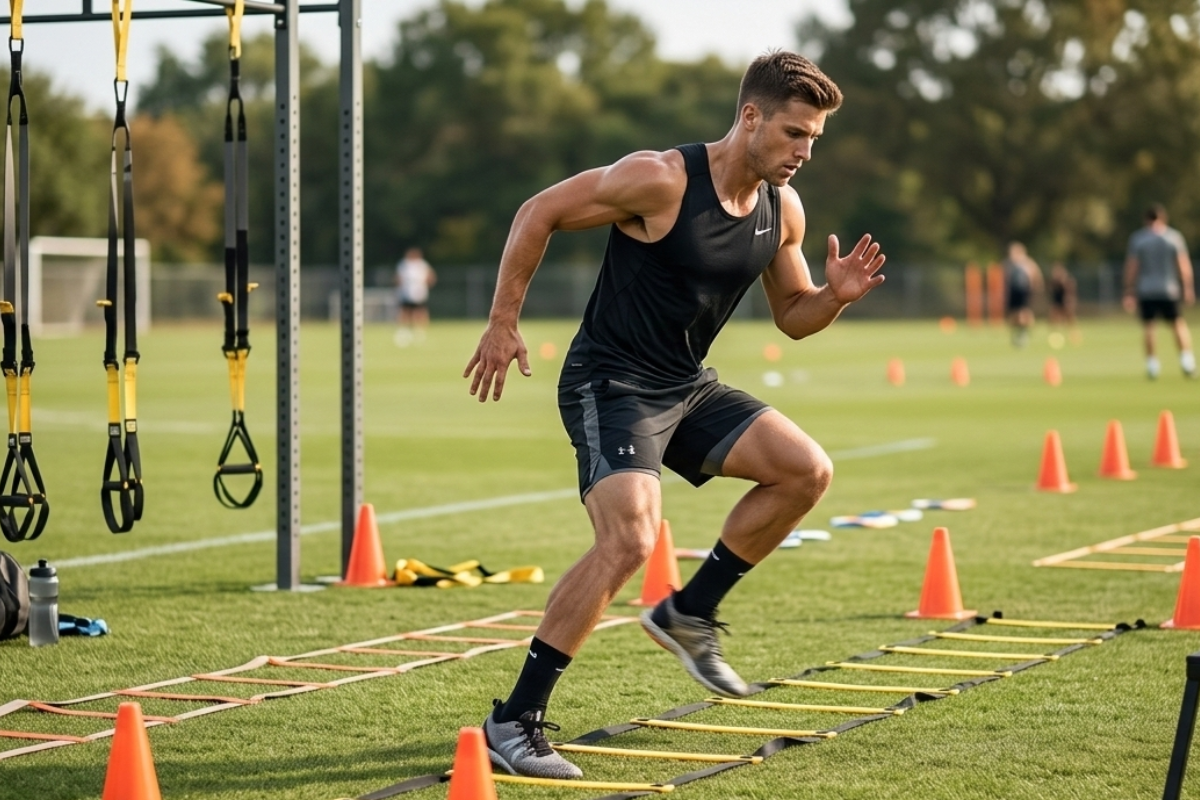

You can train your techniques for hours, but that alone won't prepare your body for the full demands of a fight. Martial arts workout routines that combine striking, grappling, and defending require strength, power, and stability that drilling moves just can't build.
If you want to hit harder, move faster, and outlast your opponent, you need functional strength training.
This article covers six exercises specifically chosen because they mirror the movement patterns you actually use in martial arts. You'll learn proper form for each one, why it translates directly to performance, and how to fit these into your current training. Some use just your bodyweight; others add suspension trainers or kettlebells for extra challenge.
Let's get into it.
What Makes an Exercise "Functional" for Martial Artists
Functional exercises copy the movement patterns you actually use when fighting. Bicep curls train one muscle, doing one thing. That's fine for bodybuilding, but fighting doesn't work that way.
When you throw a punch, your legs push off the ground, your hips rotate, your core tightens, and your arm extends all at once. Combat conditioning teaches these muscle groups to fire together, which is exactly what happens during a kick, a sprawl, or a clinch exchange.
Martial arts make specific demands on your body: explosive hip power for strikes and takedowns, push-pull strength for punching and clinching, rotational force to whip kicks and hooks around, and core stability to connect everything without falling apart.
The best fighters train for movement quality, not muscle size. Wrestling coaches talk about being strong in "weird positions" because that's where fights happen.
You don't need beach muscles. You need strength that shows up on the mat when someone's trying to take your head off.
1. Push-Ups
Push-ups are the foundation for anyone who throws punches. The pushing motion you use to press yourself off the floor is the same pattern your body uses to extend a jab or cross. Boxing, Muay Thai, karate, it doesn't matter. They all rely on this movement.
This isn't just a chest exercise. When you do it right, you're training the whole chain of muscles that fire when you punch. Professional fighting training equipment can enhance this movement pattern, but proper bodyweight technique comes first.
How to perform a push-up:
-
Place your hands directly beneath your shoulders.
-
Keep your elbows tucked close to your ribs as you lower down.
-
Maintain a straight line from your head to your heels.
-
Brace your core the entire time.
-
Lower until your chest nearly touches the floor.
-
Push back up to the starting position.
Why Push-Ups Work for Fighters
The muscle activation that drives you up from the bottom of a push-up is identical to what happens when you extend your arm to land a shot.
Adding instability with TRX suspension training systems forces your shoulder stabilizers to engage harder, which builds protection against the jarring impact of hitting pads, bags, or opponents. That extra stability work pays off when you're throwing hundreds of punches in a session.
Push-Up Variations by Training Level
Beginners should start with incline push-ups, hands elevated on a bench or step, to build strength before going horizontal.
Intermediate athletes stick with standard push-ups, focusing on crisp form and a full range of motion.
Advanced fighters can add clapping push-ups for explosive punching power, diamond push-ups to strengthen the triceps for arm extension, or TRX suspended push-ups to challenge stabilizer muscles and build shoulder resilience.
2. Squats
Squats are the king of lower-body training for fighters. Strong legs power your kicks, launch your takedowns, and give you the stable base you need to throw strikes without getting pushed around.
Taekwondo, BJJ, wrestling, Muay Thai, they all demand leg strength. If you can't squat deep with good form, you probably have hip mobility problems that are limiting how high you can kick and how low you can get in grappling exchanges.
The squat tells the truth about what your body can actually do. For wrestlers specifically, specialized wrestling training equipment can complement these fundamental movement patterns.
How to perform a squat:
-
Stand with feet shoulder-width apart or slightly wider, toes pointed out a bit.
-
Push your hips back and bend your knees to lower yourself like you are sitting in a chair.
-
Keep your chest up and back straight throughout the movement.
-
Go as deep as your mobility allows while keeping your heels planted and toes grounded.
-
Make sure your knees track over your toes, not collapsing inward.
-
Drive through your heels to stand back up while squeezing your glutes and pushing your hips forward.
How do Squats Transfer to Kicks and Takedowns?
The power in a squat comes from triple extension, where your ankles, knees, and hips all straighten at once to drive you upward. That exact same movement launches a round kick or shoots you into a wrestling takedown.
The squat pattern is so fundamental to fighting that improving it will show up immediately in your performance on the mat or in the ring.
Squat Variations by Training Goal
Jump squats build the explosive power you need for fast level changes and snapping kicks.
Goblet squats, where you hold a TRX YBell or kettlebell at your chest, add resistance and teach you to stay upright under load.
TRX-assisted deep squats let you use suspension straps for balance while you sink lower than normal, opening up the hip mobility required for head kicks and wrestling from awkward bottom positions.
3. Burpees
Nobody loves burpees. They're awful in the moment, and that's exactly why they work.
The movement combines a wrestling sprawl with an explosive stand-up, which is literally what happens when someone shoots on you, and you have to defend and recover.
One rep hits your entire body through multiple planes of movement while your heart rate goes through the roof. These functional movement patterns form the foundation of advanced MMA techniques.
How to perform a burpee:
-
Start standing with your feet shoulder-width apart.
-
Drop into a squat and place your hands on the floor.
-
Kick your feet back into a plank position.
-
Perform a push-up.
-
Jump your feet forward to your hands.
-
Explode upward into a jump with your arms overhead.
The Burpee-to-Sprawl Connection
The floor-to-feet transition in a burpee is the same motor pattern you use when you sprawl on a takedown attempt and scramble back to your feet. Train enough burpees and that sequence becomes automatic. Your body stops thinking about it and just does it. Fighters who regularly include burpees in their conditioning develop faster scramble responses because they've drilled that explosive recovery hundreds of times. Add them to circuits to mimic the anaerobic chaos of sparring rounds, where you're working hard, hitting the ground, and getting back up over and over.
4. Kettlebell Swings
Kettlebell swings are the best exercise for building the explosive hip power that drives kicks, throws, and takedowns. The hip hinge pattern teaches you to generate force from the ground, through your core, and out into whatever you're trying to hit or throw. Your arms don't do the work here. All the power comes from that hip snap, which is the same mechanic that makes round kicks land hard and takedowns actually finish.
How to perform a kettlebell swing:
-
Stand with feet slightly wider than shoulder width.
-
Hinge at your hips while keeping your back flat.
-
Grip the kettlebell with both hands, arms extended.
-
Drive your hips forward explosively to swing the weight up to chest height.
-
Let the kettlebell fall back as you hinge again, absorbing the momentum.
-
Repeat the hip snap immediately for the next rep.
Hip Hinge Mechanics and Fighting Power
The hip hinge is the single most important force-production pattern for fighters. When you throw a round kick, the power starts in your hips snapping forward. When you finish a wrestling shot, your hips drive through your opponent. Thai clinch knee strikes fire from hip extension. Judo hip throws rotate around your hips as the fulcrum. Train the kettlebell swing and you're drilling the movement that shows up everywhere in fighting. The TRX YBell works great for swings since it functions as both a kettlebell and dumbbell, giving you options as you progress.
This explosive hip drive is essential for high-intensity MMA cardio workouts that replicate fight demands.
Kettlebell Swing Variations and Loading
Start with two-hand swings to learn the pattern and build consistency in your hip hinge. Once that feels automatic, move to single-arm swings, which add an anti-rotation demand as your obliques fight to keep you from twisting. That's the same core loading you experience when throwing hooks and crosses. Use sets of 15-25 reps for conditioning work, or go heavier with 8-12 reps when you're focused on power development. Master the movement before chasing heavy weight.
5. Pull-Ups
Pull-ups are essential for grapplers and strikers alike. Strong lats and grip strength let you control opponents in the clinch, execute throws, and maintain guard position when someone's trying to pass. A strong back also keeps your posture solid and protects against the injuries that pile up during hard training. Avoid kipping or swinging when you do these. Strict pull-ups build the raw pulling strength fighters actually need, not the momentum-based reps that look impressive but don't transfer to the mat.
How to perform a pull-up:
-
Grip the bar slightly wider than shoulder width with palms facing away.
-
Hang with arms fully extended and shoulders engaged.
-
Pull your body up by driving your elbows down toward your hips.
-
Continue until your chin clears the bar.
-
Lower yourself with control back to the starting position.
Grip Strength and Grappling Performance
Grip is often the deciding factor in grappling exchanges. In BJJ, Judo, and wrestling, whoever controls the grips usually controls the fight. The forearm and hand strength you build through strict pull-up training transfers directly to controlling sleeves, collars, and wrists. When your grip outlasts your opponent's, you dictate where the fight goes.
These pulling patterns directly support the comprehensive training approach outlined in our complete MMA workout guide.
Pull-Up Progressions for All Levels
TRX rows or ring rows work as a beginner entry point, building the pulling pattern at an adjustable angle before you go vertical. Band-assisted pull-ups help intermediate athletes who can't yet complete full reps but need to practice the actual movement. Strict bodyweight pull-ups are the standard for competent fighters, building functional pulling strength without assistance. Weighted pull-ups using a belt or vest challenge advanced athletes who need more resistance to keep progressing.
6. Rotational Core Exercises
Rotational force separates average fighters from powerful ones. Punches, kicks, and throws all originate from hip and core rotation. The two exercises below train both the strength and speed components of that rotation.
Russian Twists
Russian twists build the twisting power used in punches, kicks, and throws. The ability to generate and resist rotational force is what separates good fighters from great ones. A TRX YBell or medicine ball works well for this exercise. Adding weight increases difficulty, but prioritize controlled movement over heavy load. Quality reps build rotational strength. Sloppy reps just train bad patterns.
How to perform Russian twists:
-
Sit with knees bent and feet flat on the floor or elevated.
-
Lean back slightly while keeping your spine straight.
-
Hold weight at your chest or extend your arms in front of you.
-
Rotate your torso to one side while keeping your hips stable.
-
Rotate to the opposite side in a controlled motion.
-
Continue alternating, driving the movement from your obliques, not your arms.
Medicine Ball Rotational Throws
Medicine ball throws are the explosive power version of rotational core training. While Russian twists build strength, rotational throws develop the speed needed to actually land punches and kicks with knockout power. This trains the same force production pattern as throwing a hook or rear cross. You can also perform this using TRX Rip Trainer rotational training, which specifically trains rotational power and anti-rotation stability while building spine health for long-term training durability.
How to perform medicine ball rotational throws:
-
Stand sideways to a wall or facing a partner.
-
Hold the ball at hip level on your outside hip.
-
Explosively rotate through your core while throwing the ball against the wall or to your partner.
-
Catch or retrieve the ball and reset your position.
-
Repeat for desired reps, then switch sides.
Anti-Rotation Training: Why It Matters for Fighters
Anti-rotation training, which means resisting unwanted twist, is just as important as generating rotation. When absorbing a punch, clinching, or defending a takedown, your core must resist rotation to protect your spine and maintain position. Exercises like the Pallof press or TRX Rip Trainer anti-rotation holds develop this quality. You brace against a force trying to twist you rather than creating the twist yourself, and that stability shows up every time someone tries to move you against your will.
For fighters looking to develop complete rotational power and stability, comprehensive fighting training equipment provides the tools needed to train these patterns effectively.
How to Structure a Martial Arts Workout With These Exercises
Integrate functional training with your martial arts practice by adding 2-3 strength sessions per week on non-sparring days. Heavy sparring and intense strength training should not happen on the same day. Your body needs time to recover, and stacking hard sessions just leads to burnout or injury. A simple structure works best: warm up with dynamic stretches and mobility work, perform 3-4 exercises from this list for 3-4 sets each, then cool down with light stretching. Total session should take 30-45 minutes. Martial arts practice is still the priority. Strength work supports skill development, not the other way around.
Consistency beats intensity every time. Doing these exercises twice weekly for months will build more fighting strength than crushing yourself once then skipping a week because you're too sore to move. Start with bodyweight variations and master the movement patterns before adding load. Equipment like suspension trainers and kettlebells come later as you progress and need more challenge.
These functional movement patterns are also featured in our specialized TRX for MMA training approach.
Sample Weekly Training Schedule
This template keeps strength sessions away from your hardest martial arts days and gives your body time to adapt. If you train martial arts more frequently, adjust by dropping to two strength sessions and spacing them further apart.
Beginner vs. Intermediate Programming Notes
Beginners should stick to all bodyweight exercises, train twice per week, and focus entirely on nailing proper form before worrying about intensity. Your body needs to learn the movement patterns first. Intermediate athletes can add load through kettlebells or TRX equipment, bump up to three sessions per week, and introduce plyometric variations like jump squats and clapping push-ups for explosive power development. Pick the starting point that matches where you actually are, not where you want to be.
Common Mistakes Martial Artists Make With Strength Training
Training too heavy too early. This happens most often with kettlebell swings. Fighters grab a weight that looks impressive and then compensate with terrible form, which builds bad habits and invites injury. Master the movement pattern with lighter loads before chasing numbers.
Prioritizing muscle size over movement quality. Hypertrophy training that bodybuilders use will slow you down. You're not trying to look big. You're trying to move fast and hit hard. Bulk without function is dead weight in a fight.
Skipping rotational and anti-rotation work entirely. Most fighters do some version of push, pull, and squat movements but completely neglect the transverse plane. That's a problem because punches, kicks, and throws all generate power through rotation. If you only train forward and backward, you're leaving power on the table.
Strength training on the same day as hard sparring. Both activities demand serious recovery resources from your body. Stack them together and you'll either get hurt, overtrain, or just spin your wheels because your body can't adapt to either stimulus properly. Space them out and let your system actually rebuild.
Equipment Options: Training With or Without Gear
All six exercises in this article can be performed with zero equipment using bodyweight only. Push-ups, squats, burpees, and pull-ups need nothing but your body and something to hang from. You can do Russian twists without weight and practice rotational throws with any heavy object you have around. Bodyweight training built fighters for centuries before commercial gyms existed, and it still works.
That said, equipment upgrades add resistance, instability, and portability when you're ready for more challenge:
-
Kettlebells load up your hip hinge work and goblet squats with scalable resistance.
-
TRX Rip Trainer Pro Kit adds instability to push-ups and provides a progression path for pull-ups through rows and assisted variations.
-
TRX YBell functions as both a kettlebell and dumbbell in one piece, making it useful for swings and rotational exercises without cluttering your space.
-
TRX Rip Trainer specifically targets rotational power and anti-rotation stability for fighters who want to develop that plane of movement.
These tools work well for home training or travel, but they're upgrades, not requirements. Start with your body and add gear when bodyweight alone stops challenging you. High-quality suspension trainers offer the versatility to progress through all levels of these functional movement patterns.
For comprehensive training solutions, our specialized Rip training for martial artists program combines rotational power with functional strength development.
Build Strength That Actually Shows Up in the Ring
Functional strength training bridges the gap between being technically skilled and being physically dominant. These martial arts workout exercises build exactly what martial artists need: explosive power, pushing and pulling strength, rotational force, and core stability. They work because they mirror actual fighting patterns. Push-ups build punching power. Squats power kicks. Kettlebell swings develop hip drive. Pull-ups strengthen clinch control. Rotational exercises create knockout power.
Start with the bodyweight movements and progress from there. For those ready to level up, TRX Strike training systems and YBells let you train these martial arts workout patterns anywhere with minimal equipment. The work you put in off the mat shows up when it counts.