
You walk into a gym and spot two black straps anchored overhead, dangling at chest height. Someone leans back into the handles, presses their feet into the floor, and pulls their chest toward the straps in a controlled row. No barbell. No machine. Just body weight, gravity, and a pair of straps doing all the work.
That is suspension training, and it has quietly become one of the most efficient ways to build strength, stability, and mobility without a rack of equipment. Here is the short version of what makes it work, what it builds, the gear you need, and a beginner-ready workout you can run today.
Suspension Training, Defined
Suspension training is a form of bodyweight strength training that uses two adjustable straps anchored to a single fixed point overhead. Slot your hands or feet into the straps and gravity plus your own body weight become the load, working every major muscle group and keeping the core under tension on every rep.
A few things separate this from a normal floor-based bodyweight workout. The straps are unstable by design, so smaller stabilizer muscles fire on every rep. You change the difficulty by changing your body angle, not by loading plates. And because your feet or hands are tied to the same anchor, the core has to hold the whole system rigid through every movement.
That setup is the bridge into the mechanics. Once you understand how the angle dial and instability work together, every exercise on a Suspension Trainer™ starts to make sense.
How Suspension Training Works
Three principles do the heavy lifting. Gravity and body weight create the load. Body angle controls how heavy that load feels. Instability multiplies the demand on stabilizers and the core.
Body angle is the part most lifters underrate. The more vertical you stand, the less of your body weight you have to move. The more horizontal you lean, the more of it you are fighting. This is the one place in fitness where you control resistance with your foot position, not a stack of plates. A row that feels easy can become punishing in two steps forward.
The straps themselves move freely on every rep. That forces the small stabilizing muscles around your shoulders, hips, knees, and core to work alongside the prime movers. Research published in the Journal of Strength and Conditioning Research found that suspended plank variations produced significantly higher abdominal muscle activation than floor-based planks, with the strongest effect when the arms were in the straps. When the surface under you stops being stable, your core picks up the work.
TAKE OUR TRAINING QUIZ
The Origin Story, From a Navy SEAL Deployment to a Global Training Method
TRX® was invented in the late 1990s by Navy SEAL Randy Hetrick. Deployed to places with no gym and no equipment, he needed a way to stay in fighting shape using whatever he could find. The first prototype was a jiu-jitsu belt rigged with parachute webbing. The first Suspension Trainer was the result.
The method scaled up fast. Today TRX® has certified more than 300,000 trainers across 30-plus countries, and the gear is in use by all four branches of the U.S. military, MLB clubs, UFC fighters, and Olympic-level athletes. The original constraint, training hard with one piece of gear in a tight space, is exactly why suspension training still works at home, in a garage, in a hotel room, or hanging from a tree branch in your backyard.
7 Benefits of Suspension Training (Backed by Research)
Suspension training delivers full-body strength, mobility, and stability gains with one piece of gear. The benefits below are the ones that hold up across the research and across real-world coaching. None of this is hype.
1. Builds Full-Body Functional Strength
Suspension training covers every fundamental movement pattern, including push, pull, squat, hinge, lunge, and rotation. Because nearly every exercise is closed-chain, with your hands or feet anchored, the load travels through multiple joints at once. That is how your body moves in life and sport, which is why functional strength built on the straps transfers cleanly into running, lifting, and athletics.
2. Trains the Core on Every Rep
No bench supports your spine. No machine holds you in place. Your core has to brace through every pull, press, squat, and curl to keep your body in a straight line. The same research showing higher abdominal activation during suspended planks reflects what happens across the rest of the system. When the system under you is unstable, the core does not get a rep off.
3. Improves Balance, Mobility, and Joint Stability
The unstable straps recruit the small stabilizers around your shoulders, hips, and ankles on every movement. Over time, that work transfers into better balance, smoother movement, and joints that hold up under load. This ties straight back to the TRX® mission of helping you move better, grow stronger, and live longer.
4. Low-Impact on Joints
No barbell pressing down on your spine. No plyometric pounding through your knees. Body angle controls the load, so you can build real strength without the compressive stress that comes from heavy bar work. That is part of why older lifters and athletes managing wear and tear lean on suspension training to keep training hard without breaking down.
5. Scales for Any Fitness Level
This is where the body-angle principle pays off. A complete beginner can stand close to the anchor and run an easy row. An advanced lifter can walk their feet far under the anchor for a near-horizontal pull that lights up the back and core. Same exercise, vastly different difficulty. One tool, infinite progressions, no plate changes.
6. Trains Anywhere With One Anchor Point
A Suspension Trainer weighs about two pounds and rolls up small enough to drop in a carry-on. Anchor it to a door, a beam, a sturdy tree, a pull-up bar, or a wall mount, and you have a full gym. That portability kills the most common excuse for skipping a workout, because the gym is wherever the anchor is.
7. Time-Efficient Full-Body Sessions
A 20 to 30 minute suspension training session can hit every major movement pattern with one piece of gear. You transition between strap positions in seconds rather than walking between machines or swapping plates. For anyone fighting against a packed schedule, that efficiency is the whole point.
Pair our Suspension Trainer with the TRX Training Club to get word-class TRX workouts from trained professionals!

Who is Suspension Training For?
Beginners get the most obvious win. The body-angle dial means you can scale every exercise to your level on day one. No equipment change, no spotter, no plate math.
Intermediate and advanced lifters get something different. The instability and unilateral options expose weaknesses a barbell hides. The single-arm row, the assisted pistol squat, the suspended push-up. None of those let you compensate.
For older adults, the low joint stress and easy load adjustments make it a sustainable way to build strength while staying off the floor and out of squat racks.
Athletes get the rotational, multi-planar, and sport-specific patterns a fixed implement cannot match. The TRX® RIP Trainer™ pushes that further into explosive rotational power for baseball, golf, tennis, and MMA.
First responders and active duty? The original use case still applies. Train hard, travel light, keep working.
One quick note before you start. Talk to your physician before beginning any new exercise routine, especially if you are coming back from injury.
What Equipment Do You Need to Start?
The short answer is simple. One Suspension Trainer and one solid anchor point. That is the minimum viable kit.
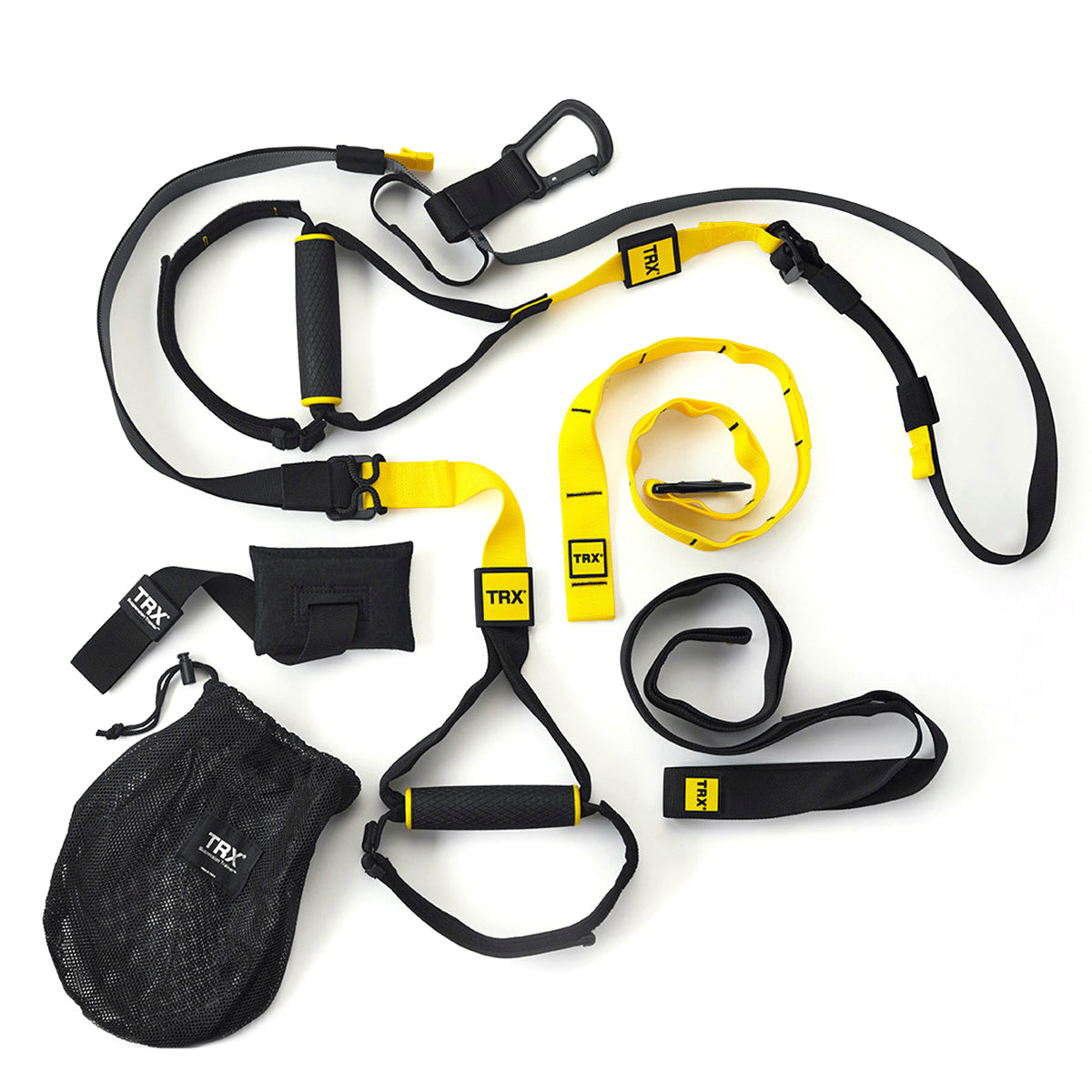
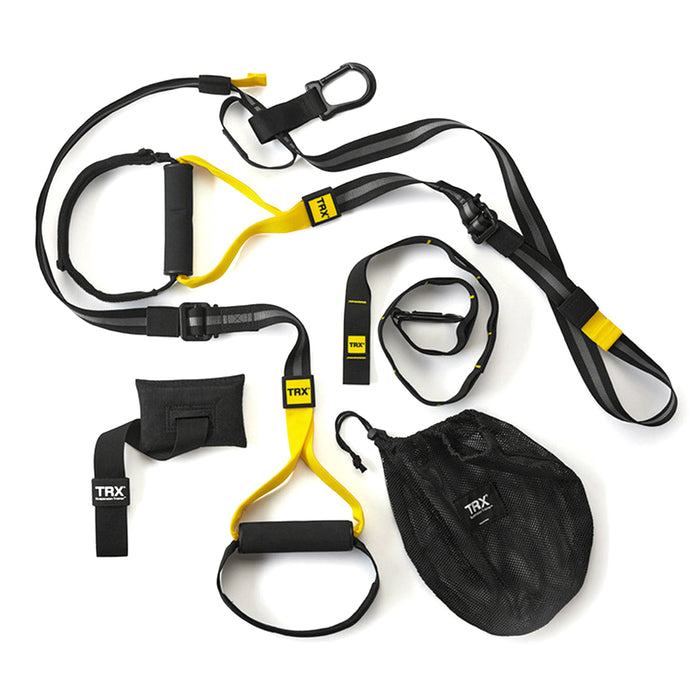
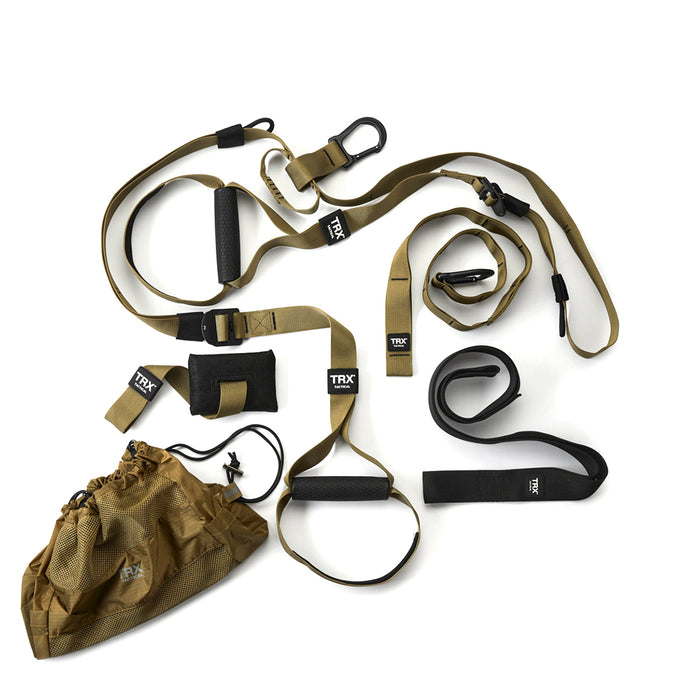
The TRX® Suspension Trainer is the original tool. It weighs about two pounds, runs on adjustable strap length, and uses foot cradles and rubberized handles for both grip and comfort. TRX® offers two main consumer systems. The TRX® Home2 System ($199) is built for at-home use. The TRX® Pro4 System ($249) steps up to commercial-grade durability for heavier use.
Anchor options stay simple.
-
An overhead beam or door anchor for indoor home use
-
A wall mount or TRX® X-Mount for permanent installs
-
A sturdy tree branch or pull-up bar for outdoor training
-
A TRX® Suspension Anchor strap for posts, railings, or other fixed structures
The exercises below assume your strap is anchored at roughly 7 to 9 feet overhead.
If you eventually want to layer in other tools, the broader ecosystem is built to connect. The TRX® RIP Trainer adds rotational power work, the TRX® YBell™ doubles as a dumbbell, kettlebell, and push-up stand, and the TRX® Bandit™ adds variable resistance to bodyweight moves. The Suspension Trainer is still the starting point.
5 Suspension Training Exercises to Try Today
These five exercises cover every major movement pattern with one tool. One pull, one push, one squat, one hinge, and one anti-extension hold. Run them in order for a quick full-body session.
1. TRX® Row
The row is the foundation pulling pattern on a Suspension Trainer. It trains your upper back, biceps, and rear delts while demanding full-body bracing through the core, glutes, and legs.
-
Set the straps to mid-length and face the anchor.
-
Grip one handle in each hand with palms facing each other.
-
Walk your feet forward to lean back into a straight body line.
-
Brace your core and lock your hips in line with your shoulders.
-
Pull your chest toward the handles with your elbows close to your ribs.
-
Lower back to the start with control.
Form cues to lock in. Keep your body in one rigid line from head to heels, do not let your hips sag, and drive your elbows down and back. Scale by walking your feet forward to make it harder or back to make it easier. Aim for 8 to 12 reps.
2. TRX® Chest Press
The chest press flips the row. It trains the chest, shoulders, triceps, and core in one closed-chain push pattern, and the moving straps make every rep more demanding than a floor push-up.
-
Set the straps to mid-length and face away from the anchor.
-
Grip one handle in each hand at shoulder height.
-
Walk your feet back to create a lean.
-
Brace your body in a straight line from head to heels.
-
Lower your chest between your hands by bending your elbows.
-
Press back to the start.
Form cues to lock in. Keep your hands just outside your shoulders, elbows at roughly 45 degrees from the body, and hips locked in line with the shoulders. Breathe out on the press. Aim for 6 to 10 reps.
3. TRX® Squat
The TRX® Squat is the entry point into bodyweight squatting for anyone working on depth, knee control, or ankle mobility. The strap provides just enough support to let you focus on form before adding load.
-
Set the straps to mid-length and face the anchor.
-
Grip one handle in each hand at chest height with light tension on the straps.
-
Stand with your feet shoulder-width apart.
-
Sit your hips back and down as if into a chair.
-
Keep your chest tall and your knees tracking over your toes.
-
Drive through your heels to stand.
Form cues to lock in. Use the straps for balance, not as a pull-up assist. Sit back into your heels and drive your knees out to track your toes. Aim for 10 to 15 reps.
4. TRX® Hamstring Curl
The hamstring curl is one of the few bodyweight movements that genuinely loads the posterior chain. It builds the hamstrings, glutes, and lower back in a single eccentric-heavy pattern that transfers directly into running, jumping, and lifting.
-
Set the straps to mid-calf length.
-
Lie on your back with your feet placed into the foot cradles and arms flat on the floor.
-
Lift your hips so your body forms a straight line from shoulders to heels.
-
Curl your heels toward your glutes by bending your knees.
-
Control the extension back to the start.
Form cues to lock in. Keep your hips high through the rep, do not let your lower back arch, and squeeze your glutes at the bottom of the curl. Aim for 8 to 12 reps.
5. TRX® Plank
The TRX® Plank turns a stable floor plank into a full-stability challenge. Feet in the foot cradles forces every deep stabilizer in your hips, spine, and shoulders to fire on every breath.
-
Anchor your Suspension Trainer overhead and set the straps to mid-calf length.
-
Place your toes into the foot cradles facing the floor.
-
Lift into a forearm plank with your elbows under your shoulders.
-
Brace your core, squeeze your glutes, and breathe.
Form cues to lock in. Anchor first, body second. Settle into the foot cradles before lifting your hips. Keep your hips in line with your shoulders, and exhale through pursed lips to maintain the brace. Run 3 sets of 15 to 30 seconds.
How to Get Started With Suspension Training
Anchor selection comes first. Pick a point overhead that is weight-rated, fixed, and free of obstructions in the swing path. A solid beam, a properly installed wall mount, or a heavy-duty pull-up bar all work.
Strap length follows the exercise. Mid-length covers most pulls and presses. Mid-calf works for the plank and hamstring curl. Fully shortened straps are right for biceps curls and similar standing pulls.
Session structure stays simple. Run a short warm-up, pick 4 to 6 exercises across the major movement patterns, and work through 2 to 3 rounds in 20 to 30 minutes.
Train 2 to 4 sessions per week with rest days between hard sessions. The TRX® Training Club™ App layers structured programming on top of that, with 500-plus on-demand workouts led by TRX®-certified coaches if you want a guided start.
One last principle for beginners. Scale by changing your body angle before adding sessions, reps, or rounds. Walk your feet forward for harder rows and presses. Walk them back to deload. The strap and the floor are the only two variables you need to manage on day one.
Start Suspension Training With TRX® Training
Most home strength routines force a trade-off between a real training stimulus and gear that fits the space you have. Suspension training is the rare method that delivers both, which is why more than 300,000 certified TRX® coaches teach it across 30-plus countries and why the same tool sits in U.S. military training centers, MLB clubhouses, and Olympic facilities. The TRX® Suspension Trainer is that tool. It weighs about two pounds, anchors anywhere overhead, and scales from a beginner's first row to elite rotational and unilateral work without ever asking you to buy another piece of gear.
If you are ready to start, pick up a TRX® Suspension Trainer and pair it with guided beginner programming in the TRX® Training Club App. Train 2 to 4 times a week, scale by angle before you scale by volume, and let the reps compound. Move better. Grow stronger. Live longer.