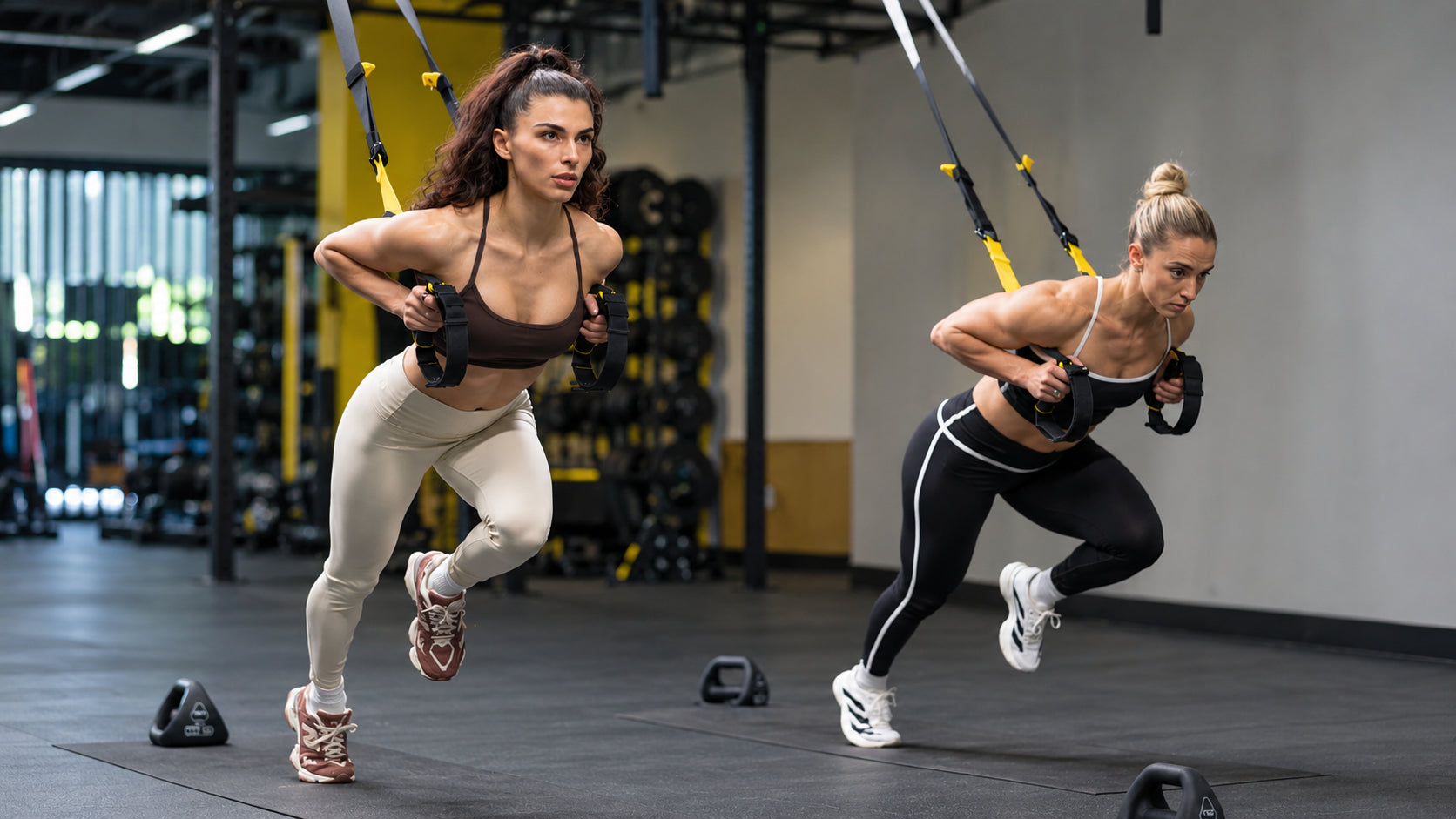

Suspension training for soccer can complement field training and gym work when the exercises, resistance, technique, and weekly placement match the player. This TRX soccer workout gives you eight exercise options, a 30-minute template, progression rules, and practical ways to fit strength work around practices and matches.
Suspension training is one tool, not the whole program. It cannot replace ball work, sprinting, plyometrics, change-of-direction practice, appropriate heavy loading, or individualized coaching. If you have pain, an injury, or a return-to-play restriction, follow your clinician and performance staff instead of a general workout.
Key Takeaways: Suspension Training for Soccer
-
Suspension training can complement soccer strength and conditioning by loading useful squat, lunge, hinge, push, pull, hamstring, and trunk patterns, but it does not replace field practice or other purpose-built training.
-
The sample session pairs lower-body, upper-body, hamstring, and trunk work, with each set stopping before technique or tempo breaks down.
-
Body angle and foot placement let you scale resistance, but a harder variation only counts as progress when position and control stay sound.
-
When a soccer player needs one setup that scales across the session, the TRX® Home2 Suspension Trainer™ includes adjustable foot cradles and two anchor options, and a coach can adjust body angle, range, tempo, and hand support for the player.
-
Place the hardest accessory-strength session where it least disrupts soccer quality, then shorten, lighten, or skip it when practice or match congestion already creates a high load.
What Soccer Players Need From a Suspension Workout
A useful soccer strength session builds general physical qualities without pretending to copy the game. Start with single-leg strength, knee-dominant and hip-dominant patterns, hamstring and glute work, trunk control, plus enough pushing and pulling to keep the session balanced.
A 2026 systematic review and network meta-analysis compared 53 randomized trials involving 1,580 soccer players and found that different training modes favored different outcomes. That supports matching the method to the goal. It does not validate this exact suspension routine or guarantee better match performance.
Use suspension exercises for the patterns they can load well. Keep acceleration, maximal-speed running, plyometrics, agility, and technical work in the parts of the program built for those tasks. Broader athlete guides can provide multi-sport ideas, and this guide stays focused on soccer-specific exercise selection, dosage, and weekly placement.
Set Up the Suspension Trainer Safely
Start every session by checking the anchor, straps, floor, and movement path before you add meaningful load. Confirm that footwear provides stable contact. Follow the manufacturer's setup instructions for the exact suspension trainer and attachment. Use a door, tree, pole, post, or beam only when the manufacturer confirms that setup is compatible.
Check the Anchor, Straps, and Training Space
Test the system gradually before you lean, press, pull, or place your feet in the cradles. Cleveland Clinic exercise physiologist Christopher Travers, MS, advises using a secure anchor and following the manufacturer’s instructions because body position, strap length, and what is suspended all change the exercise.
-
Inspect the straps, handles, foot cradles, stitching, and attachment for visible damage or unusual wear.
-
Attach the system exactly as directed, close or lock the attachment as designed, and apply light tension before adding more bodyweight.
-
Clear enough floor space for the full movement, then check that shoes and the training surface provide stable contact.
Stop for sharp pain, dizziness, loss of control, or symptoms outside normal exertion. Unfamiliar movements deserve a qualified coach’s eyes, especially when the feet are suspended.
Choose Resistance With Body Angle and Range
Choose a position that lets you complete the target repetitions with controlled range and a clear reserve before failure. In standing rows and presses, a more upright position usually reduces the bodyweight challenge. A steeper angle often increases it, but the exact relationship changes by exercise.
The TRX® Home2 Suspension Trainer™ includes door and suspension anchors plus adjustable foot cradles. In this session, that setup lets a coach move from standing rows and presses to floor-based hamstring and trunk work with one system, then scale each exercise through angle, range, tempo, or hand support. That keeps equipment changes simple, but the coach still needs to choose a compatible anchor and a resistance the player can control. The system does not produce a soccer outcome on its own.
Use Technique Stop Rules
End the set when the target position or tempo breaks down, not when the straps finally win. Stop for shortened range, swinging, shoulder shrugging, knee collapse, uncontrolled trunk rotation, or repeated pulling with the arms during a leg exercise.
A 2025 review of resistance-training variables in soccer favored full usable range and non-failure work for several performance goals and noted that ideal loading and rest depend on the outcome. For this template, technique controls the dose. Add rest or reduce the angle when the next repetition will not look like the last good one.
8 Suspension Exercises for Soccer Strength and Conditioning
These eight TRX exercises for soccer are a menu, not a command to perform all eight in one session. The sample workout selects six. Use the reverse lunge and crossing balance lunge as substitutions when they fit the player better. The broader TRX workouts for athletes guide offers more multi-sport ideas without replacing this soccer-specific selection.
1. TRX Supported Single-Leg Squat
The TRX supported single-leg squat trains knee-dominant single-leg strength, and adjustable hand support helps you control range. It does not reproduce sprinting, cutting, or kicking.
-
Face the anchor, hold the handles with light tension, and balance on one foot with the other leg reaching forward.
-
Sit the hips down and back as the working knee tracks in line with the foot, using only enough arm support to keep control.
-
Press through the whole foot and stand tall without yanking on the handles or twisting the pelvis.
Start with 2 to 3 sets of 6 to 10 controlled repetitions per side and 60 to 90 seconds of rest. Regress with more arm assistance or less depth. Progress range first, then reduce assistance as alignment stays steady.
2. TRX Reverse Lunge
For split-stance leg strength, the TRX reverse lunge offers enough support to make position and range easier to manage than a suspended-foot variation for many players.
-
Face the anchor with light handle tension, stand tall, and step one foot back.
-
Lower both knees under control, keeping the front foot planted and the pelvis square.
-
Drive through the front leg to return, keeping the straps quiet and the arms relaxed.
Use 2 to 3 sets of 6 to 10 repetitions per side with 60 to 90 seconds of rest. To make it easier, shorten the range or add support. Build depth, slower lowering, or less support before you consider external load.
3. TRX Single-Leg Hip Hinge
Use the TRX single-leg hip hinge to train a hip-dominant pattern, balance, and posterior-chain control. Sprint speed and hamstring health still depend on the wider program.
-
Face the anchor, soften the stance knee, and keep only light tension on the handles.
-
Push the hips back as the free leg reaches behind you, keeping the ribs and pelvis controlled.
-
Press the stance foot into the floor and squeeze the glute to return tall without pulling yourself up.
Aim for 2 to 3 sets of 6 to 8 repetitions per side with 60 to 90 seconds of rest. A kickstand stance or smaller range makes the movement easier. From there, add range, slow the lowering phase, or use less hand support.
4. TRX Hamstring Curl to Glute Bridge
On the floor, the TRX hamstring curl to glute bridge trains the hamstrings and hip extensors through a controlled pattern. It is one option among hamstring exercises for soccer players, not an injury-prevention guarantee.
-
Lie under the anchor with your heels secure in the foot cradles and your legs extended.
-
Lift the hips without arching the lower back, then pull the heels toward the hips, keeping the pelvis level.
-
Extend the knees slowly and keep the hips controlled before lowering at the end of the set.
Begin with 2 to 3 sets of 8 to 12 repetitions and 75 to 120 seconds of rest. A bridge hold or shorter curl reduces the challenge. Keep the hips elevated through every repetition before a coach considers a single-leg version.
5. TRX Crossing Balance Lunge
The TRX Crossing Balance Lunge adds controlled frontal and transverse-plane exposure with hand support. Treat it as a coordination and strength option, not a simulation of cutting.
-
Face the anchor, keep light tension on the handles, and plant the stance foot firmly.
-
Reach the other leg behind and across only as far as the stance knee and pelvis remain controlled.
-
Drive through the stance hip to return to center without twisting the knee or swinging through the straps.
Start with 2 sets of 6 to 8 repetitions per side and 60 to 90 seconds of rest. Regress to a shallower crossing reach or lateral step-down. Progress range and control before speed. Review the TRX Crossing Balance Lunge guide for the brand’s movement details.
6. TRX Row
The TRX row trains the upper back and adds pulling strength to balance the pressing work in a general athletic program. That is reason enough to use it.
-
Face the anchor and lean back with a straight line from head to heels and the straps under tension.
-
Draw the shoulder blades and elbows back as the chest moves toward the handles without shrugging.
-
Lower under control, keeping the hips level and the body rigid.
A practical starting point is 2 to 3 sets of 8 to 12 repetitions with 60 to 90 seconds of rest. Stand more upright to reduce the challenge. Walk the feet closer to the anchor only when the body line and shoulder position stay controlled.
7. TRX Chest Press
Use the TRX chest press for horizontal pushing and trunk stiffness in a standing bodyweight pattern. Its role is balanced upper-body preparation, not direct transfer to a soccer skill.
-
Face away from the anchor, place the handles near the ribs, and brace in a straight line from head to heels.
-
Bend the elbows and lower the body between the hands without letting the straps rub the arms.
-
Press away, keeping the ribs down and the hips from sagging.
Use 2 to 3 sets of 8 to 12 repetitions with 60 to 90 seconds of rest. Stand more upright for an easier version. Add a steeper angle or greater range only when the shoulders and trunk stay organized.
8. TRX Body Saw
Under a changing lever, the TRX body saw trains trunk control and bracing. Use it as a general core exercise for soccer players, not as a recreation of every demand of kicking, contact, or running.
-
Place the feet securely in the cradles and set a strong forearm plank with the straps quiet.
-
Move the body a small distance backward from the shoulders without letting the lower back sag or the hips pike.
-
Return to the start under control and stop the set if the straps swing or shoulder position deteriorates.
Begin with 2 to 3 sets of 6 to 10 slow repetitions or 15 to 30 seconds, resting 60 to 90 seconds. A floor plank is the easier option. Add range before duration, and omit the movement when the setup or shoulder position is not appropriate.
A 30-Minute TRX Soccer Workout
This 30-minute TRX soccer workout uses six familiar movements in a compact soccer strength session and keeps technical quality ahead of fatigue. It is a starting template for healthy, trained readers. Age, training history, position, practice load, and the rest of the week should change the final dose.
Use about 5 minutes for preparation, 20 to 22 minutes for the paired strength blocks, and 3 to 5 minutes for an easy finish and notes. Setup changes and active coaching can extend the clock.
|
Block |
Exercise |
Sets |
Reps or time |
Rest |
Coaching focus |
|---|---|---|---|---|---|
|
Preparation |
Easy movement, squat or lunge, low-effort row, rehearsals |
1 |
4 to 5 min |
As needed |
Check readiness, range, and anchor |
|
Block A |
Supported single-leg squat + TRX row |
3 rounds |
6 to 8 per side + 8 to 12 |
60 to 90 sec after pair |
Light support and a straight body line |
|
Block B |
Single-leg hip hinge + TRX chest press |
3 rounds |
6 to 8 per side + 8 to 12 |
60 to 90 sec after pair |
Square pelvis and stable ribs |
|
Block C |
Hamstring curl to glute bridge + body saw |
2 rounds |
8 to 12 + 6 to 10 |
75 to 120 sec after pair |
Level hips and controlled trunk |
|
Finish |
Easy walk and session notes |
1 |
3 to 5 min |
None |
Log angle, range, faults, and soreness |
Warm up with easy movement, ankle and hip mobility, a bodyweight squat or lunge, a low-effort row, and one rehearsal of each first-block exercise. Keep the preparation easy enough to notice stiffness, poor range, or an unstable setup before the working sets begin.
If pairing exercises reduces technique or recovery, use straight sets with longer rest. Reverse lunges and crossing balance lunges can replace a lower-body movement rather than adding more mandatory volume.
Fit the Workout Around Training and Matches
Place the hardest accessory-strength work where it least interferes with high-quality soccer practice and match readiness. Then adjust from the player’s response instead of treating a calendar template as a rule.
A 2026 systematic review of 43 studies found a common elite-team pattern of recovery after matches, higher loading around match day minus four or minus three, and tapering near the next match. Only two included studies directly tested performance effects, so the pattern describes common practice more strongly than it proves an ideal schedule.
Off-Season or Preseason
Two nonconsecutive sessions per week can be an initial preseason template when the wider plan allows it. Start at the low end of the set range, keep at least a day between substantial strength sessions, and coordinate with sprint, plyometric, and field intensity.
A small 2023 study of 20 boys ages 13 to 15 used TRX sessions twice weekly after soccer training for eight weeks. That protocol cannot establish a universal schedule for adults, girls, different competitive levels, or this exact workout.
One-Match Week
For in-season strength training in soccer, a main session around match day minus four or minus three can fit a one-match week when it matches the team plan. Keep later work shorter and lighter, and avoid unfamiliar high-soreness variations close to the match.
A 2011 trial of 14 professional male players found that one weekly in-season strength session maintained prior gains better than one session every second week during its 12-week protocol. The sample was small, the players were professionals, and the study did not test this suspension session.
Two-Match or Congested Week
Matches, recovery, and soccer practice take priority during congested weeks. A short maintenance dose, movement rehearsal, or no extra suspension session may be the better choice when another strength exposure would reduce quality.
If the staff wants a brief exposure, choose two to four familiar movements, one or two sets, and conservative angles. Youth players, injured players, and anyone with club or medical restrictions should follow their qualified coach and clinician.
Progress the Workout Without Chasing Fatigue
Progress one main variable at a time and keep the movement recognizable. Earn the rep target first, then increase usable range, improve tempo and control, adjust body angle, and only then consider a more complex variation.
-
Use the low end of the set and rep ranges, then record the angle, assistance, and technique faults.
-
Add one or two clean repetitions where every set stayed controlled.
-
Keep the repetitions steady and add a little range, a slower lowering phase, or a slightly harder angle.
-
Reduce total sets or use easier variations when the player needs a lower-volume week.
This four-week example is illustrative, not a fixed program. A harder angle is not progress if the range shortens, the straps swing, or the target position disappears.
When to Use Something Besides Suspension Training
Choose another tool when it matches the intended adaptation better. Heavier external loading may be more useful when the goal requires resistance that body-angle training cannot provide or quantify well. A barbell, dumbbells, machines, bands, or another setup may give the coach better control.
Sprinting, plyometrics, agility, change-of-direction practice, and ball work need suitable field space, exposure, and coaching. A broader functional strength training guide can help you compare movement patterns, but it still does not replace sport practice.
Pain, injury, rehabilitation, and return-to-play decisions belong with licensed clinicians and the player’s performance staff. Do not use a general article to override restrictions or to select an injury-specific progression.
Frequently Asked Questions
The right suspension-training dose depends on the player, schedule, and purpose. These short answers are starting points, not universal prescriptions.
Is TRX Good for Soccer Players?
A TRX workout for soccer can be useful as one strength and conditioning tool when the exercise choice and loading fit the player. It can cover supported single-leg work, posterior-chain exercises, rows, presses, and trunk training. It does not replace sprint exposure, plyometrics, appropriate heavy strength work, sport practice, or individualized coaching.
How Often Should Soccer Players Do a TRX Workout?
Two preseason sessions and about one main in-season session per week are reasonable starting examples, not rules. Adjust for training age, practice load, match schedule, soreness, and other strength work. During a two-match week, a reduced dose or no extra session may protect the quality that matters more.
Can Suspension Training Replace Weights?
Suspension training can cover many useful movement patterns, but it cannot replace every loading or power-development tool. Choose according to the adaptation, resistance needed, equipment access, coaching, and player experience. Free weights may be a better option when precise, heavier loading is the priority.
Build the Session Around the Player
Build a TRX soccer workout around movements the player can perform well, place the session where it supports the week, and progress only when technique and recovery justify it. Keep the routine compact and purposeful. More fatigue is not the same as better preparation.
If this suspension session fits the wider plan, use our soccer training equipment collection to compare a Suspension Trainer with complementary tools by the job each needs to do. Start with the movement patterns the week is missing, verify the setup, and choose only equipment the player can use with sound programming and coaching. A qualified strength coach should review team programming, and a licensed clinician should guide pain, injury, or return-to-play decisions.
References
Amylon, Robin, et al. “Soccer Strength Training.” Mass General Brigham.
Du, Shuyuan, et al. “The Optimal Dose of Strength and Conditioning Training for Enhancing Physical Performance in Football Players: A Systematic Review and Network Meta-Analysis of Randomized Clinical Trials.” Frontiers in Physiology, vol. 17, 6 July 2026.
Bartolomei, Sandro, et al. “Manipulating Resistance Exercise Variables to Improve Jumps, Sprints, and Changes of Direction in Soccer: What We Know and What We Don’t Know.” Journal of Functional Morphology and Kinesiology, vol. 10, no. 2, 2025, article 145.
Lafrance, Guillaume, et al. “Impact of Weekly Workload Distribution on Performance in Male Soccer Players Across Competitive Levels: Scientific Hypothesis or Empirical Evidence.” Journal of Strength and Conditioning Research, 20 Oct. 2026.
Gürgen, Kerem, and Hilal Kılınç Boz. “The Effect of TRX Exercise Program on Sporting Performance of 13–15 Years Old Male Football Players.” Journal of Sport for All and Recreation, vol. 5, no. 2, 2023, pp. 85–93.
Rønnestad, Bent R., et al. “Effects of In-Season Strength Maintenance Training Frequency in Professional Soccer Players.” Journal of Strength and Conditioning Research, vol. 25, no. 10, 2011, pp. 2653–2660.
Cleveland Clinic. “How Best To Use Suspension Trainers for Your TRX Workout.” Cleveland Clinic, 18 Sept. 2026.