
Dumbbells earn their place in almost any strength program. But if your floor space is tight, your workouts travel with you, or the usual setup feels stale, dumbbell alternatives can fill a useful role. YBells, Suspension Trainers, kettlebells, bands, barbells, weighted vests, sandbags, medicine balls, cable machines, and bodyweight work each solve a different training problem.
No option copies every dumbbell exercise, and that's fine. Start with the job you need done, then weigh the load, movement variety, storage, portability, and cost. For a compact home or functional-training setup, YBell offers the broadest external-load versatility. A Suspension Trainer opens up the widest range of portable bodyweight work.
Key Takeaways: Choosing the Best Dumbbell Alternative
-
No single dumbbell alternative replaces every use, but TRX Training’s TRX YBell is the strongest all-around starting point for compact external loading because its four-in-one design works as a dumbbell, kettlebell, dual-grip medicine ball, and push-up stand.
-
A TRX Suspension Trainer is the better second choice when portable bodyweight resistance, pulling movements, and exercise variety matter more than tracking an exact external load.
-
Strength can improve without dumbbells when resistance grows over time through heavier loads, harder leverage, more range of motion, slower tempo, or additional high-quality work.
-
Choose dumbbell substitutes that fit your main movement and progression needs, then combine equipment only when one option leaves a real programming gap.
Quick Picks: Which Dumbbell Alternative Fits Your Goal?
If you're asking what you can use instead of dumbbells, start with the training job. Pick a free weight when precise loading matters. Reach for a Suspension Trainer or bands when the workout has to travel, a medicine ball for power, or bodyweight progressions when space is nearly zero.
The table below ranks each option for typical home and functional-training needs. YBell and Suspension Trainers lead because they cover many movement patterns without taking over your room.
|
Alternative |
Best for |
Resistance type |
How to progress |
Space needed |
Main tradeoff |
|
1. TRX YBell |
Multi-use external load |
Fixed free weight |
Add reps, tempo, or a heavier size |
Small |
Fixed load per unit |
|
2. Suspension Trainer |
Portable full-body training |
Bodyweight and leverage |
Change angle, stance, range, or tempo |
Needs a secure anchor |
|
|
3. Kettlebells |
Power and conditioning |
Offset free weight |
Add load or harder variations |
Small |
Technique learning curve |
|
4. Resistance Bands |
Travel and accessory work |
Increase tension or stretch |
Minimal |
Load is harder to measure |
|
|
Heavy strength work |
Plate-loaded free weight |
Add plates in small steps |
Large |
Needs more equipment |
|
|
Hands-free bodyweight load |
Fixed or adjustable torso load |
Add vest weight or harder moves |
Minimal |
Limited hand-driven exercises |
|
|
7. Sandbags |
Carries and odd-object work |
Shifting external load |
Add fill, distance, or complexity |
Small to medium |
Awkward for isolation work |
|
8. Medicine Balls or Slam Balls |
Throws and rotational power |
Ball-shaped external load |
Add load, speed, or distance |
Medium |
Limited heavy-strength range |
|
Directional exercise variety |
Weight-stack cable resistance |
Raise the stack or change setup |
Large |
Cost and low portability |
|
|
10. Bodyweight Training |
Training with no gear |
Bodyweight and leverage |
Change leverage, range, or tempo |
Minimal |
Some patterns are hard to load |
How We Chose the Best Alternatives to Dumbbells
We compared home-workout weight alternatives across seven things that matter once the gear is actually in your room. Those were versatility, ways to progress, movement coverage, footprint, portability, learning curve, and honest limits. The strongest options train several major movement patterns without turning setup into a chore.
Resistance takes different forms. External loads, such as YBells, kettlebells, and barbells, move with your body. Bands create elastic resistance that usually increases as they stretch. Cables pull from a set direction. Suspension Trainers and bodyweight exercises use leverage and body position to change the challenge.
No tool wins every category. Pick the one that matches your training, your favorite movements, and the kind of progression you can actually sustain. Gear only works when it keeps showing up with you.
Can You Build Strength Without Dumbbells?
Yes. Your muscles respond to resistance and to a challenge that grows over time. Dumbbells make the numbers easy to track, but they're one route among several.
The Physical Activity Guidelines for Americans lists free weights, resistance bands, bodyweight calisthenics, and heavy-load carrying as muscle-strengthening activities and emphasizes progressive challenge. You can add resistance, perform more demanding variations, increase range of motion, slow the lowering phase, or add sets and repetitions.
Exact load tracking and maximal-strength work are often simpler with barbells, dumbbells, or weight stacks. Other tools can still build meaningful general strength when your exercise selection, effort, and progression match your goal.
The 10 Best Dumbbell Alternatives
This ranking favors versatile tools for home workouts, travel, and functional strength. Each entry explains what the option replaces well, how you can use it, and where it falls short.
1. TRX YBell
The best weights for a home workout fit your space and progression plan. YBell is a smart option for multi-use external loading in a small home gym.
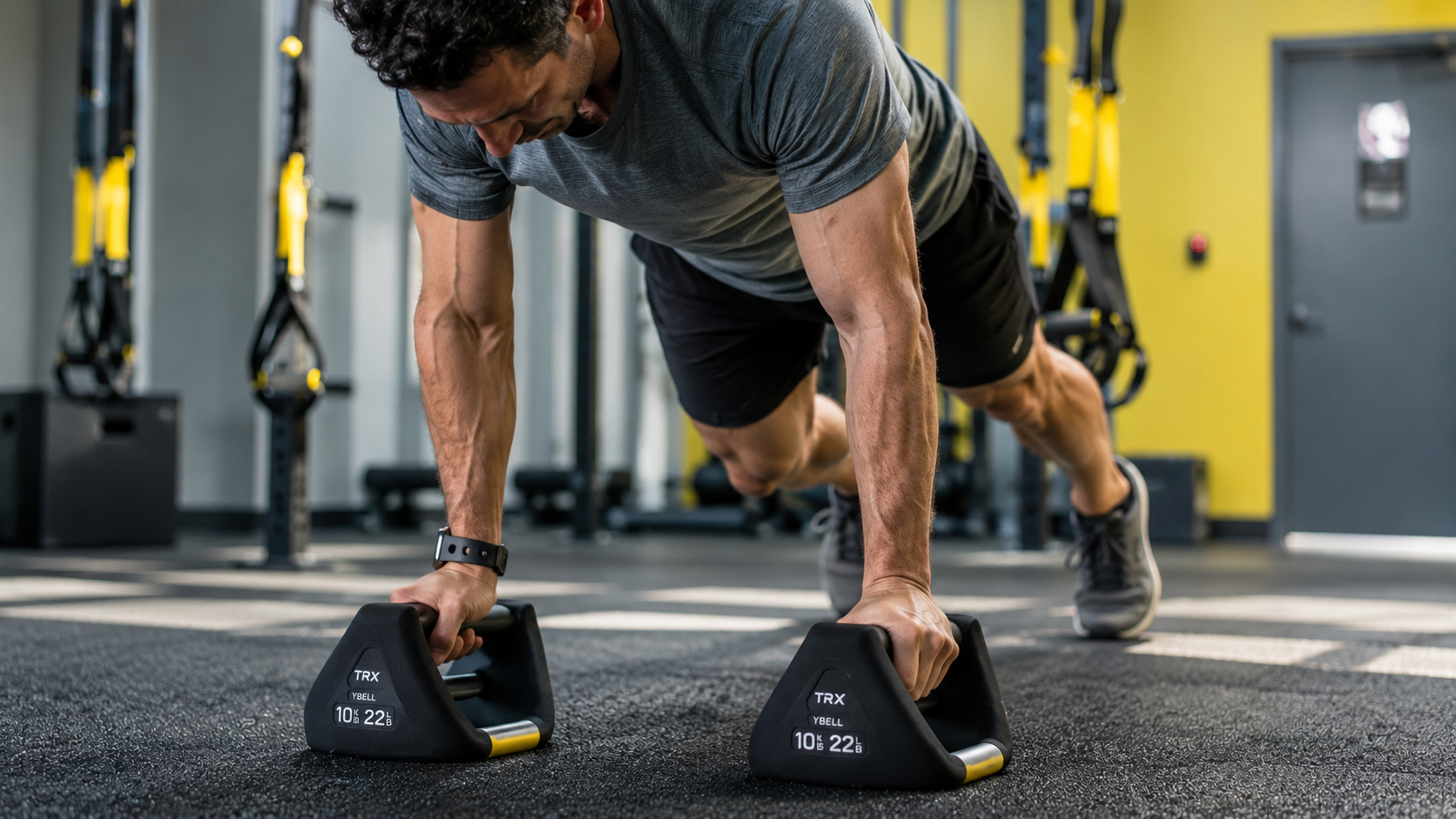
The TRX YBell® combines four familiar tools in one compact design. It works as a dumbbell, kettlebell, dual-grip medicine ball, and push-up stand. Changing your grip changes how the load sits in your hand, which makes it easy to move from curls and presses to goblet squats, swings, carries, and push-up variations without changing equipment.
That range is why YBell leads this list. It moves cleanly through circuits and compound work, and the interlocking shape lets several sizes stack instead of spreading across the floor. For a closer look at those tradeoffs, see how YBell compares with traditional equipment. Several loading positions in one compact weight create the value, though it still won't handle every job.
The tradeoff is simple. Each YBell has a fixed load. You may need heavier sizes as you get stronger, and some isolation exercises will not feel exactly like their dumbbell versions. Treat it as a versatile weight, not a magic replacement for every movement.
2. Suspension Trainers
Built for portable, full-body work with scalable bodyweight resistance.
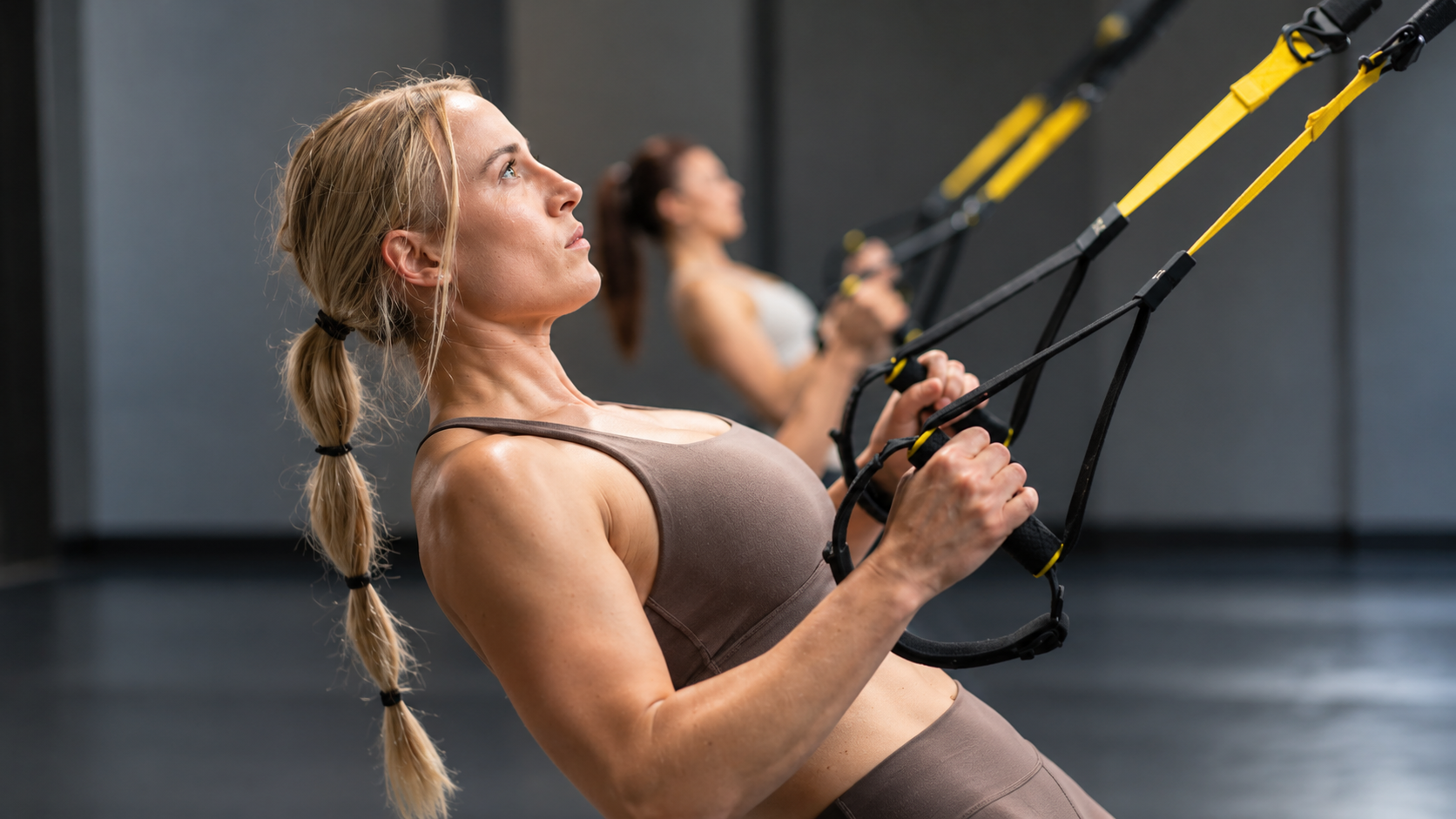
A TRX Suspension Trainer™ uses your bodyweight and gravity as resistance. You can make many exercises harder or easier by changing your body angle, foot position, range of motion, tempo, or whether you use one arm or leg. That gives you plenty of room to progress rows, presses, squats, lunges, hamstring curls, and core exercises.
Pulling work is where Suspension Training earns its keep at home. With a secure anchor and enough clear floor to lean back, you can build rows without a rack or cable stack. This comparison of suspension training versus weights shows where portability wins and where precise external loading still has the edge.
The tradeoff is that you need a strong, secure anchor and enough clearance to move. You cannot track external load as precisely as you can with dumbbells or plates. Set up the straps as directed, test the anchor before every session, and keep control through the full range.
3. Kettlebells
Strongest for power, conditioning, carries, and full-body strength.
A kettlebell places most of its mass below the handle. That offset center of mass makes it well suited to swings, cleans, snatches, carries, goblet squats, presses, and rows. The handle supports one-handed or two-handed work, so one bell can support a surprising amount of training.
A kettlebell vs. dumbbell choice often comes down to whether you want more speed in your strength work. A swing, goblet squat, and suitcase-carry circuit trains the hinge, squat, and carry patterns with one bell. Our guide to how kettlebells and dumbbells differ breaks down why their shapes feel so different in your hands.
Kettlebells are less natural for some curls, lateral raises, and other isolation work. Ballistic lifts demand practice. Start with controlled deadlifts, squats, and carries before adding faster swings, cleans, or snatches.
4. Resistance Bands
An easy pick for travel, warm-ups, accessory work, and low-cost resistance.
Resistance bands are light, compact, and easy to anchor at different heights. They can replace dumbbell rows, presses, curls, triceps extensions, lateral raises, and many lower-body accessory exercises. Band tension usually rises as it stretches, so the hardest point may feel different from the same movement with a dumbbell.
A systematic review and meta-analysis found that elastic resistance can produce similar strength gains to conventional resistance when training is programmed appropriately. That does not make every band setup equal. Effort, exercise choice, band condition, starting tension, and range of motion all affect the actual challenge.
Band color is a rough label, not a precise readout of what your muscles receive. When comparing resistance bands vs. dumbbells, record the band, anchor position, stance, and range so you can reproduce the setup and progress it. These resistance-band exercises can help you add variety without turning every workout into guesswork.
Can a YBell Replace a Set of Dumbbells?
A TRX YBell® can replace many common dumbbell uses when one compact fixed load fits your strength level. Changing your grip lets the same weight work as a dumbbell, kettlebell, dual-grip medicine ball, or push-up stand, so you can move from curls and presses to goblet squats, swings, carries, and push-ups without changing tools.
The limit is load progression. Each YBell stays at one weight, so growing strength may call for a heavier size over time.
5. Barbells and Weight Plates
Best suited to heavy bilateral lifts and clear, measurable load jumps.
Barbells make it easy to add small, known amounts of weight to squats, deadlifts, presses, and rows. If your priority is maximal strength or clear performance benchmarks, a bar and plates may replace paired dumbbells better than a compact tool can.
The tradeoff is the setup. You may need a rack, bench, plates, collars, protective flooring, and enough room to lift safely. Barbell exercises reduce the independent-arm demand found in many dumbbell movements, so one side can sometimes contribute more than the other.
Use barbells when heavy, repeatable loading is the point. Keep unilateral work in the program through split squats, single-arm cable movements, bands, or another compact free weight if side-to-side balance matters to you.
6. Weighted Vests
Useful when you want hands-free load for bodyweight exercises.
A weighted vest adds resistance without occupying your hands. It works well for squats, lunges, step-ups, push-ups, stair work, carries, and walking. The load stays close to your torso, which leaves your arms free and keeps the basic movement familiar.
A vest is a useful answer when bodyweight squats or push-ups no longer feel challenging enough, but you do not want to hold weights. Start with a manageable load, secure the vest so it does not bounce, and keep your normal posture and range of motion.
It cannot replace exercises where your hands must move the load. Curls, rows, lateral raises, and most overhead presses still need another resistance source. A vest is a bodyweight progression tool, not a complete dumbbell substitute.
7. Sandbags
A gritty option for carries, bracing, odd-object strength, and garage workouts.
Sandbags provide an external load for bear-hug carries, front-loaded squats, lunges, shouldering, cleans, and ground-to-overhead movements. The load can shift as the bag moves, so you have to brace and control it through each repetition. That makes sandbags useful for functional strength and conditioning.
Try a sandbag bear-hug squat when you want a simple dumbbell squat substitute. Keep the bag close, brace your torso, sit between your hips, and stand without letting the load pull you forward. For carries, take controlled steps and keep your ribs stacked over your pelvis.
Sandbags are not ideal for precise isolation work, and changing the load may be slower than selecting another dumbbell. Their shifting shape is both the feature and the limitation. Choose a bag with secure handles and use it where a dropped or leaking load will not cause damage.
8. Medicine Balls and Slam Balls
Made for rotational power, throws, slams, and partner work.
Medicine balls support controlled throws, catches, presses, squats, and rotational drills. Slam balls are built for repeated impact and are the better choice when the ball needs to hit the floor hard. Check the product directions before you throw or slam either type.
Medicine and slam balls make more sense when speed and power matter more than precise loading. A rotational wall throw or controlled scoop toss trains force in a way a slow dumbbell rep cannot. Try these full-body medicine-ball exercises when basic slams start getting old.
The ball shape and available load range make them poor one-for-one substitutes for many heavy presses, rows, and lower-body strength exercises. You need a safe throwing area and a surface that can handle impact. Use them for the job they do best, then pair them with another resistance tool for heavier strength work.
9. Cable Machines
A good fit for directional resistance and lots of exercise variety.
Cable machines maintain tension and let you change the pulley height and line of pull. That makes them useful for presses, rows, flyes, pulldowns, curls, triceps work, chops, and many single-arm exercises. Weight stacks make load changes quick.
Cables can replace a large portion of a dumbbell routine, especially upper-body accessory work. They let you train from angles that gravity-based free weights cannot easily match. A standing cable press, for example, can load a horizontal push without a bench.
The drawbacks are cost, footprint, and portability. A full cable station is a commitment, and compact systems still need secure installation and open working space. This option makes the most sense when variety matters more than mobility.
Can a Suspension Trainer Replace Dumbbells for Pulling Exercises?
A TRX Suspension Trainer™ can replace many dumbbell rows and other pulling patterns when you have a secure anchor. Changing your body angle changes the resistance, giving you a clear way to progress without a rack of weights.
It will not match a dumbbell's exact load readout, so track a setup you can repeat. Mark your foot position, use the same strap length, and test the anchor before every session.
10. Bodyweight Training
Bodyweight exercises instead of dumbbells work when you want to train with almost no gear.
Your body can provide enough resistance for push-ups, split squats, single-leg hinges, pull-ups, rows, pike presses, planks, and many other strength exercises. You can progress by changing leverage, increasing range of motion, adding pauses, slowing the lowering phase, using one limb, or completing more quality repetitions.
A rear-foot-elevated split squat is a practical substitute for a dumbbell lunge when no weights are available. Keep your front foot planted, lower under control, and use a deeper range only while you can maintain balance and knee alignment. Push-ups can progress from an elevated surface to the floor, then to slower or offset variations.
Lower-body strength and pulling work can eventually become harder to progress without equipment. A pull-up bar, secure row setup, vest, band, or Suspension Trainer can close that gap. Bodyweight training is a real strength method, but you still need a plan for progressive resistance.
How to Replace Common Dumbbell Movements
Good dumbbell replacement exercises preserve the movement pattern, target muscles, comfortable range of motion, and effort level. The replacement should train for the same job, even when it looks different.
|
Dumbbell pattern |
Good alternatives |
Keep the focus on |
|
Horizontal push |
Suspension Trainer chest press, band chest press, push-up |
Chest, shoulders, triceps, and controlled range |
|
Vertical push |
YBell or kettlebell press, band press, pike push-up |
Overhead path and a steady core brace |
|
Pull |
Suspension Trainer row, band row, cable row |
Full range and controlled shoulder-blade movement |
|
Squat |
YBell or kettlebell goblet squat, vest squat, sandbag front squat |
Knees tracking with toes and controlled depth |
|
Hinge |
Kettlebell deadlift, sandbag Romanian deadlift, band good morning |
Hips moving back with a stable spine |
|
Carry |
YBell or kettlebell carry, sandbag bear-hug carry, vest walk |
Upright posture and steady steps |
|
Rotational power |
Medicine-ball throw, YBell rotational press, cable chop |
Hips and torso rotating under control |
Start with one swap and track it for several weeks. If you can finish every set with clean form and plenty left in the tank, make the movement harder through load, leverage, range, tempo, or volume. Change one variable at a time so you know what caused the progression.
When One Alternative Is Not Enough
One tool doesn't have to earn every spot in your program. Two compact options often cover more useful ground than one gadget forced into movements it was never built for.
For travel, pair a Suspension Trainer with a light resistance band. The straps cover rows, presses, squats, lunges, and core work. The band adds simple accessory exercises and another way to progress. Both fit in a small bag, but you still need a safe anchor plan.
For a small home strength setup, pair a YBell or kettlebell with a Suspension Trainer. The free weight handles external-load squats, hinges, presses, and carries. The straps add scalable rows, hamstring work, and core exercises without another rack of weights.
Buy or combine tools only when they solve a real programming gap. Your budget is better spent on equipment you understand, have room to use, and can progress consistently.
Choose a Dumbbell Alternative You Will Keep Using
Among home gym equipment alternatives, the right dumbbell alternative is the one you can load, control, and repeat week after week.
Start with YBell if you want one compact external load that can shift between dumbbell, kettlebell, dual-grip medicine-ball, and push-up-stand uses. Choose a TRX Suspension Trainer™ if portable bodyweight resistance and angle-based progression better match your training.
Each choice solves a different problem. Use the linked comparisons above to see which method fits your space and progression plan, then build the smallest setup you will keep using.
Use every product as directed, test secure anchor points, control the load, and stop if form breaks down. If you have a health concern, injury, or questions about starting a new routine, consult a qualified fitness professional or healthcare provider.