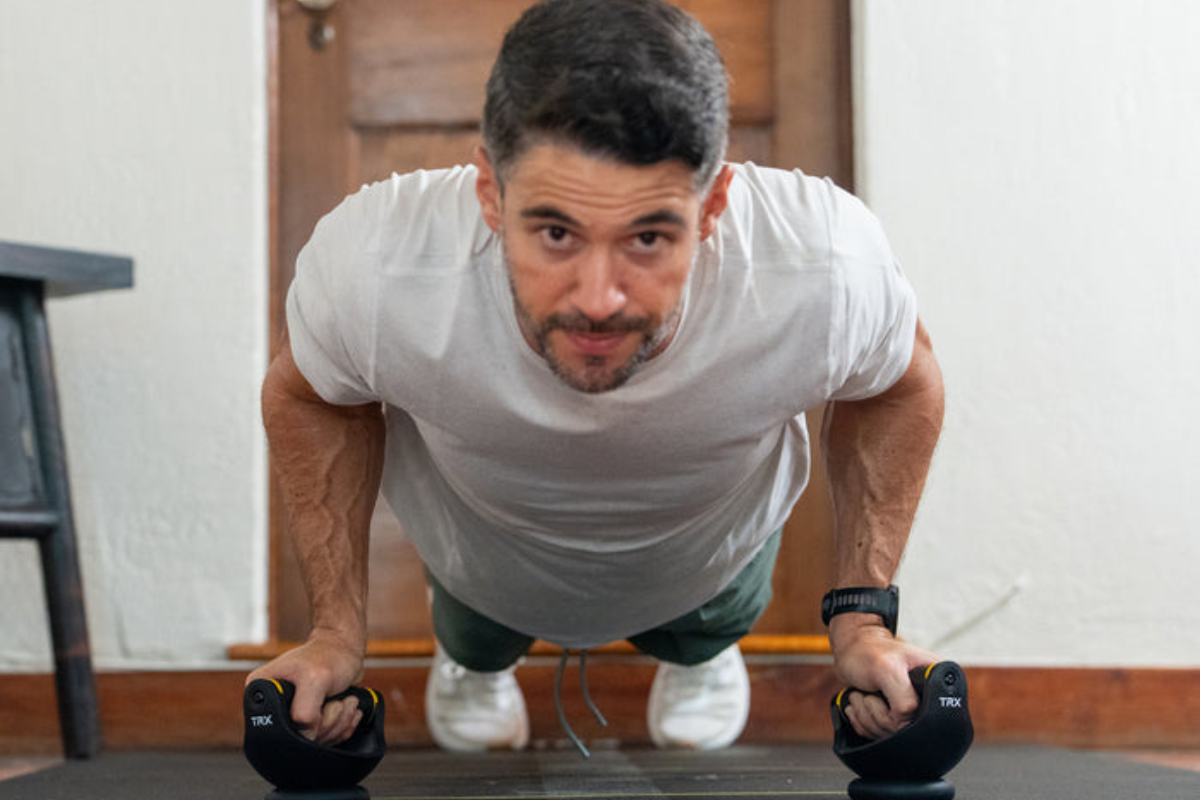

Want a stronger, more stable core without adding a ton of equipment to your space? The right push-up training tool can dramatically level up your core engagement, make progress easier to track, and help you safely increase difficulty over time.
In this guide, we'll break down the main types of push up equipment, how to use them with solid form, the best push-up variations, and how to plug everything into structured programs.
Ready to upgrade your push-ups? Keep reading.
What Are Some Benefits of Using Push-Up Tools?
Push up equipment makes each rep do more work for your core and upper body. Here is what they change right away:
-
More core activation, because push up handles, rings, or sliders wobble, and your abs have to lock everything in
-
Extra depth, so your chest, shoulders, and lats move farther and build more strength
-
Options for rotation or twisting, which hit your obliques instead of just "up and down."
-
Unilateral work, where one arm carries more load, so you build balanced strength side to side
They also treat your joints like they matter. Key things here:
-
Neutral handles that keep your wrists in a safer, straighter line
-
Smoother motion that lets your shoulders move through a better range of motion with less grinding
-
Easier progress from simple, stable setups to tougher, shaky ones, so you build strength without wrecking your joints
Why Push-Up Tools Improve Your Core Stability
Push-up training tools make your core work harder by changing how your body lines up and moves. They tweak angles, depth, and balance so your midsection has to stay braced or you tip, sag, or twist.
For example:
-
Elevated handles let you drop your chest lower, so your shoulders and chest move through a deeper range and your core has to stabilize that extra motion.
-
Push up handles also keep your wrists in a neutral position, which makes it easier to push hard without wrist pain stealing your focus.
-
Tools that rotate, like certain pushup devices or rings, light up your obliques because your body has to fight the twist on every rep.
-
Unstable tools like balls or balance platforms force your core to react fast to tiny shifts so you do not slide or roll.
All of this turns a regular push-up into a full-body checkpoint. Your spine needs to stay in a straight, strong line. Your ribs cannot flare. Your hips cannot drop.
The tool makes it very clear when you lose tension, because the movement gets wobbly or awkward. That feedback trains your core to hold steady under load, which is exactly what you want for real-life stuff like carrying bags, sprinting, or lifting anything heavy without folding like a lawn chair.
Types of Push-Up Tools
There are a few great push up equipment options that improve your core stability. These are:
Push-Up Bars and Handles
These give your wrists a neutral, straight position and let you lower your chest a bit deeper than the floor. They are light, easy to pack, and great for beginners or anyone whose wrists hate floor push-ups. Understanding the push up handles benefits can help you decide if this tool matches your training goals.
Rotating Push-Up Handles
These spin as you press, so your hands can turn naturally, and your shoulder blades (scapula) move more freely. The rotation also asks more from your obliques, since your body has to control that twist.
Push-Up Stands and Platforms
These are solid, raised surfaces that make your setup simple and stable. The extra height gives you more range of motion while keeping your body in a straight line for clean, repeatable reps. If you're working in tight quarters, check out this small space workout guide for setup ideas.
Push-Up Boards
These use color-coded slots to show where to place your hands for chest, shoulders, or triceps. The angles are pre-set to keep your shoulders in safer positions and stop you from guessing every workout. The Push It board is one example of this type of pushup device.
YBell
This odd-looking weight works as a handle, dumbbell, and push-up stand in one. You can do push-ups, carries, and presses in a tiny space, which makes it perfect for small home gyms or crowded rooms.
Learn more about YBell top grip push-up performance and why this tool delivers multiple training benefits in one compact design.
TRX Suspension Trainer
Using a TRX Suspension Trainer for push-ups transforms the exercise into a full-body stability challenge. The instability created by the straps dramatically increases core activation, improves anti-rotation and anti-extension control, and builds stronger, more resilient shoulders.
It's one of the most effective tools for integrating core stability into upper-body strength training. Master the TRX atomic push-up once you're ready for advanced progressions.
Medicine Balls / Stability Balls
These crank up the instability, so your core has to fight to keep you from rolling away. They are best for lifters who already own solid push-up form and want advanced core stability, not for your very first push-up ever. Try medicine ball push-ups when you're confident with standard variations.
How to Choose a Push-Up Training Tool
There are a few things you should consider when you pick your push-up training tool.
-
Start with your wrists.
If floor push-ups make your wrists ache, fix that first. Choose the best push up bar, handles, or a YBell Pro Series so your wrists stay in a straight, neutral line.
Skip flat hands on the ground until you can press without pain. Happy wrists mean you can actually train often. Consider exploring joint strengthening exercises to support long-term wrist health.
-
Check your space
Tiny room or shared space: Go for small tools like push up handles, a YBell, or a push-up board that slides under the bed.
If you have more room and a solid anchor point, a TRX or big stability ball can live in the corner and turn into a full-body station. You can build an effective home calisthenics workout plan using minimal equipment in small spaces.
-
Pick your stability level
If you are still learning push-up form, start with stable tools like bars, boards, or platforms.
Once your plank is rock solid, add rotating handles, TRX straps, or balls for more wobble. Stable first, chaos later. Bodyweight exercise delivers outstanding results when you master fundamentals before adding instability.
-
Be honest about your budget
On a tight budget: Simple push up equipment like bars, a basic board, or even one medicine ball can cover a lot of training.
If you can spend more, a TRX or YBell gives you push-ups plus rows, presses, and carries in one setup.
-
Match the tool to your experience
Beginners do best with fixed handles, boards, or stands that make body position easy to understand.
Intermediate and advanced lifters can chase more challenge with rotation, suspension, and unstable surfaces like balls.
Choose the tool that lets you feel in control now and still has room to grow later.
Factors You Should Consider When Looking at Push-Up Tools
-
Grip comfort
If the handles feel sharp, too wide, or slippery, you will avoid using them. Softer or slightly padded grips are better for beginners and longer sets.
Harder, thinner grips can work for advanced users who like a strong, locked-in feel for heavy, tense reps.
-
Portability
If you train in a small room or travel, choose push up equipment that fits in a bag or under a bed, like handles, a YBell, or a TRX.
Bigger tools like stability balls are better if you have a fixed home spot and do not plan to move your setup much.
-
Surface grip
The bottom of the tool should stay put when you push. Non-slip rubber bases are safer for beginners who are still learning control.
Advanced users can use more "wobbly" setups, but the pushup device itself should not skate across the floor like a hockey puck.
-
Adjustability
Some tools let you change angles, width, or height. This helps beginners find shoulder-friendly positions and slowly explore harder setups.
Advanced users can use adjustability to chase very specific goals, like narrow grips for triceps or deep deficit push-ups.
-
Durability
Cheap plastic can crack, which is exciting in a bad way. Beginners may get away with lighter gear, but if you are heavier or more advanced and plan to add explosive reps or weighted vests, choose solid metal or high-quality materials that will not wobble or bend.
-
Weight capacity
Always check how much load the tool can handle. Beginners using bodyweight only have more wiggle room.
Advanced lifters, bigger bodies, or anyone adding weight plates or vests need tools rated well above their total training weight so every rep feels safe, not sketchy.
Best Push-Up Exercises for Core Stability
One of the main benefits of push up equipment is the ability to select one that will help you increase your core stability.
Standard Push-up
-
Core focus: Hits your abs and deep core muscles that keep your ribs and hips lined up.
-
Small-space win: Needs only a body-length of floor. No gear, no drama.
-
Best tool: Basic push up handles or bars for wrist comfort and a bit more depth.
Elevated Push-up
-
Core focus: Trains your core to stay tight while your chest and shoulders move through a deeper range.
-
Small-space win: Just need a low step, platform, or sturdy stack of books.
-
Best tool: Push-up stands, platforms, or a YBell used as a handle.
Rotational Push-up
-
Core focus: Lights up your obliques and the muscles around your spine as your body twists.
-
Small-space win: You rotate in place, so the floor space does not change.
-
Best tool: Rotating push up handles or rings so your hands can spin smoothly.
TRX Push-up
-
Core focus: Makes your core fight constant wobble, especially your deep stabilizers and lower abs.
-
Small-space win: Straps hang from a door or anchor and roll up small when you are done.
-
Best tool: TRX or similar suspension trainer with adjustable strap length. The TRX door anchor upper body workout shows how to set up effective training anywhere.
YBell Push-up
-
Core focus: Trains your core to lock in while your hands grip a narrow, loaded base.
-
Small-space win: One or two YBells sit beside your bed or couch and double as weights.
-
Best tool: YBell used with the handle on top for a stable push-up stand.
Medicine Ball Push-up
-
Core focus: Demands fast, reactive core control so you do not roll off the ball.
-
Small-space win: One ball, one tiny patch of floor, lots of chaos.
-
Best tool: Firm medicine ball or small stability ball for extra wobble. Try TRX BOSU push-up progressions to build up to unstable surfaces safely.
Decline Push-up
-
Core focus: Shifts more load to your upper chest and shoulders while your core resists your hips dropping.
-
Small-space win: Feet on a couch, step, or box. Your hands stay in the same footprint.
-
Best tool: Push up bars, platforms, or a sturdy board to keep your hands level.
Close-grip Push-up
-
Core focus: Hits your triceps harder and forces your core to stop your torso from tipping side to side.
-
Small-space win: Hands move closer, not farther, so it fits in the tiniest workout zone.
-
Best tool: Narrow push up handles or a YBell held close under your chest.
How to Work Push-Up Tools into a Training Program
-
Set your weekly plan first
Train push-ups with push up equipment 2 to 4 times per week. For each session, aim for 3 to 4 sets of 6 to 12 good reps, with at least one rest day between push-up days.
Put your push-up work near the start of your workout after a short warmup, so your core and shoulders are fresh and focused. Consider following a structured 4-week workout plan to build progressive overload into your routine.
-
Climb the ladder with reps and tempo
Keep the same tool and variation until you can hit the top of your rep range with solid form. Then make it harder by slowing the way down to 3 or 4 seconds, or pausing for 1 second at the bottom.
This lets beginners and intermediate lifters grow stronger without needing new toys every week.
-
Use instability like a volume knob
Start with stable tools such as fixed handles, stands, or the best push up bar. Once those feel steady, move to slightly unstable setups like a YBell or rotating handles.
When your plank is rock solid, add higher instability with TRX or a medicine ball so your core has to fight to keep you in line.
-
Change the lever when you are ready
Easier: hands on something higher, like a bench or platform, feet on the floor.
Harder: feet up on a box or couch, hands on handles or a YBell. You can also walk your feet back in a TRX to increase the angle. Small lever changes can turn a "meh" push-up into one serious rep.
-
Follow a simple multi-week path
Week 1-2: use basic push up handles or bars, 3 sets of 8 to 10 reps, focusing on straight body, no sagging.
Week 3-4: add YBell push-ups or deeper platform push-ups, 3 to 4 sets of 8 to 12 reps. Week 5 and beyond: mix in TRX push-ups once or twice a week, starting with feet closer to the anchor, then slowly walking them back as your core stops shaking like a baby deer.
Sample Push-Up Workouts Using the Push-Up Tool You Selected
Don't forget to try out some of these sample workouts specifically designed for using a push-up training tool.
-
Beginner Core Control Circuit
Build a clean form and wake up your core. Do this 2 to 3 times per week.
-
Handled push-up on the floor
3 sets of 6 to 10 reps
Focus on a straight line from the ears to the ankles. -
Elevated push-up on a bench, step, or couch
3 sets of 8 to 12 reps
Hands a bit wider than shoulders, chest moves toward the edge. -
Forearm plank
3 sets of 20 to 40 seconds
Squeeze your glutes and ribs down so your back does not sag.
Rest 30 to 45 seconds between exercises, 60 seconds between full rounds. This circuit works well as part of a 10-minute workout at home when you're short on time.
-
Intermediate "Static but Spicy" Circuit
You stay in one spot, but your core has to work a lot harder. Do this 2 times per week.
-
TRX push-up
3 sets of 8 to 10 reps
Walk your feet forward or back to match your strength. -
YBell row in hinge stance
3 sets of 10 to 12 reps per side
Hips pushed back, torso tipped forward, row the YBell to your ribs while bracing your core. -
Rotating handle push-up
3 sets of 6 to 10 reps
Let the handles turn as you press, keep your body stiff like a plank.
Rest 30 to 45 seconds between exercises, 60 to 90 seconds between full rounds.
-
Advanced core meltdown circuit
This is for lifters who already own strong, clean push-ups. Once or twice per week is plenty.
-
TRX atomic push-up
3 sets of 6 to 8 reps
Push-up, then tuck knees toward chest while keeping hips level. -
Medicine ball push-up
3 sets of 6 to 10 reps
Hands on the ball or one hand on, one hand off, fight the wobble the whole time. -
Decline close-grip push-up on handles or YBell
3 sets of 8 to 10 reps
Feet elevated, hands narrow, ribs pulled down so you do not arch.
Rest 45 to 60 seconds between exercises, 90 seconds between full rounds. Your core should feel worked, not wrecked.
Don't Forget Safety First: Tips for Using Push-Up Tools
-
Keep your wrists in a straight line
Grip the push up handles so your knuckles point forward, and your wrists stay stacked under your shoulders.
If you feel sharp wrist pain, change the angle, switch to neutral handles, or raise your hands higher.
-
Let your shoulders move, not collapse.
As you lower, keep your shoulder blades sliding toward your spine instead of shrugging into your ears.
If your shoulders feel pinched in the front, bring your hands a bit closer to your ribs and keep your elbows at about a 30 to 45 degree angle. Try this shoulder stability workout to strengthen the stabilizing muscles around your shoulder joint.
-
Slow down the reps
Use a steady tempo both ways. Think 2 to 3 seconds down, 1 second up. If the pushup device wobbles like a haunted shopping cart, you are moving too fast for your control level.
-
Make sure the tool does not slip.
Place handles, boards, or YBells on a flat, non-slick surface. If the floor is smooth, use a mat so the base grips. Never start a set if the tool rocks or slides when you push on it.
-
Respect rotation and instability
On rotating push up handles, TRX, or balls, keep the range smaller at first and avoid big twists that crank your shoulders or spine.
If you lose your line, reduce the rotation, bring your feet closer in, or go back to a more stable tool.
-
Warm up and progress like a patient person.
Do 3 to 5 minutes of light movement, shoulder circles, and easy planks before loading hard push-ups.
Start with simpler, stable setups and only move to deeper, steeper, or shakier versions when you can do 8 to 12 clean reps without pain or weird joint noises.
From Basic Reps to Real Core Strength
Right now, push-ups might just feel like a basic upper-body move. But with the right push-up training tool, they turn into a simple way to train core stability harder, progress in clear steps, and still fit in a small home space.
Push up handles, boards, YBells, TRX, and balls all give you different ways to challenge your midline without needing a full gym.
From here, the game is consistent work and smart jumps in difficulty. Pick one pushup device that matches your wrists, your space, and your current level, plug it into a plan, and start stacking clean reps. Understanding the push up handles benefits and selecting the best push up bar for your needs will set you up for long-term progress in building genuine core strength.
References
Calatayud, Joaquin, et al. "Bench Press and Push-Up at Comparable Levels of Muscle Activity Results in Similar Strength Gains." Journal of Strength and Conditioning Research, vol. 29, no. 1, 2015, pp. 246-253. www.jssm.org/jssm-13-502.xml-Fulltext. Accessed 11 Dec. 2025.
The Citadel. "To Improve Push-Ups." The Citadel Physical Fitness, www.citadel.edu/corps/physical-fitness/to-improve-push-ups/. Accessed 11 Dec. 2025.